Why Jug Filters Struggle in Contaminant Tests: Contact Time and Pressure
A jug filter and an under-sink system can contain similar carbon and perform very differently. This explains the two physical variables that account for most of the gap, why a TDS meter cannot tell you whether either one is working, and what a jug is genuinely good at.
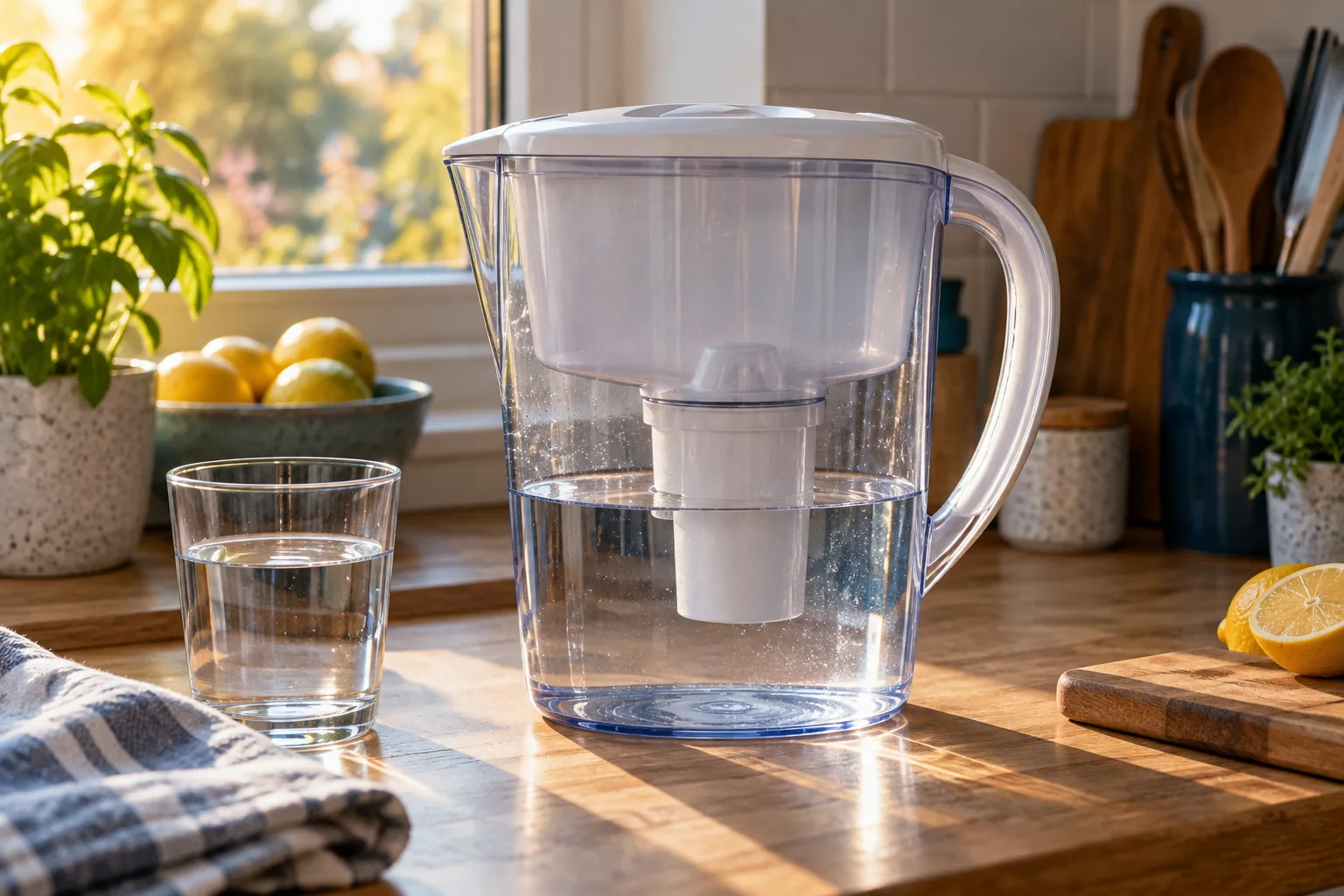
A jug filter has gravity and a few seconds of contact, where a plumbed-in system has household pressure and a denser medium. That difference in contact time and pressure, not the carbon itself, is what separates taste improvement from certified contaminant reduction.
✓ 5-Second Summary & Core Facts
- Loose carbon granules leave wide channels for water to slip through.
- Gravity gives seconds of contact; mains pressure forces even flow.
- Adsorption needs time, so flow rate is part of the performance.
- A TDS meter measures dissolved minerals, not safety.
- Jugs are genuinely effective for chlorine taste and odour.
A jug filter and a plumbed-in system can contain much the same material and produce very different results when tested against specific contaminants. The material is not usually the explanation. The physics of how water gets through it is.
Two variables do most of the work: how long the water is in contact with the medium, and what is pushing it.
Loose granules against a solid block
Most jug cartridges hold loose granules of activated carbon, sometimes mixed with an ion exchange resin. Pour water in and it runs down through the spaces between the grains.
The size of those spaces is the problem. Gaps between loose granules are wide compared with the pores in a solid compressed block of the same carbon, and water behaves the way water always does — it takes the easiest available route. Some of it threads through the widest channels and reaches the bottom having barely touched the medium at all. This is sometimes called channelling, and it gets worse as the cartridge is used and the granules settle.
A compressed carbon block has no such easy routes. Water has to pass through the material rather than around bits of it, which is both why a block performs better and why it needs pressure behind it to maintain any useful flow rate.
Contact time is part of the specification
Activated carbon does not strain anything out. It works by adsorption: certain molecules stick to the carbon's internal surface as the water goes by. That is a process that takes time to happen.
The implication is one most labels do not spell out. Flow rate and contact time are part of the performance figure, not separate from it. Push water through the same medium twice as fast and each molecule has half as long to encounter a surface it can stick to. A unit certified for a given reduction was certified at a specified flow, and exceeding that flow does not give you the certified result.
Gravity through a jug supplies very little pressure, so the water is slow — which sounds like an advantage and partly is. But slow and evenly distributed are different things. Slow water still preferentially uses the widest channel, and a channel that bypasses the medium provides no contact at any speed.
This is the same distinction between straining and adsorption we set out in our guide to the micron scale and what pore size decides. The distinction matters more here than anywhere, because jug filters are almost entirely adsorption devices.
The TDS meter problem
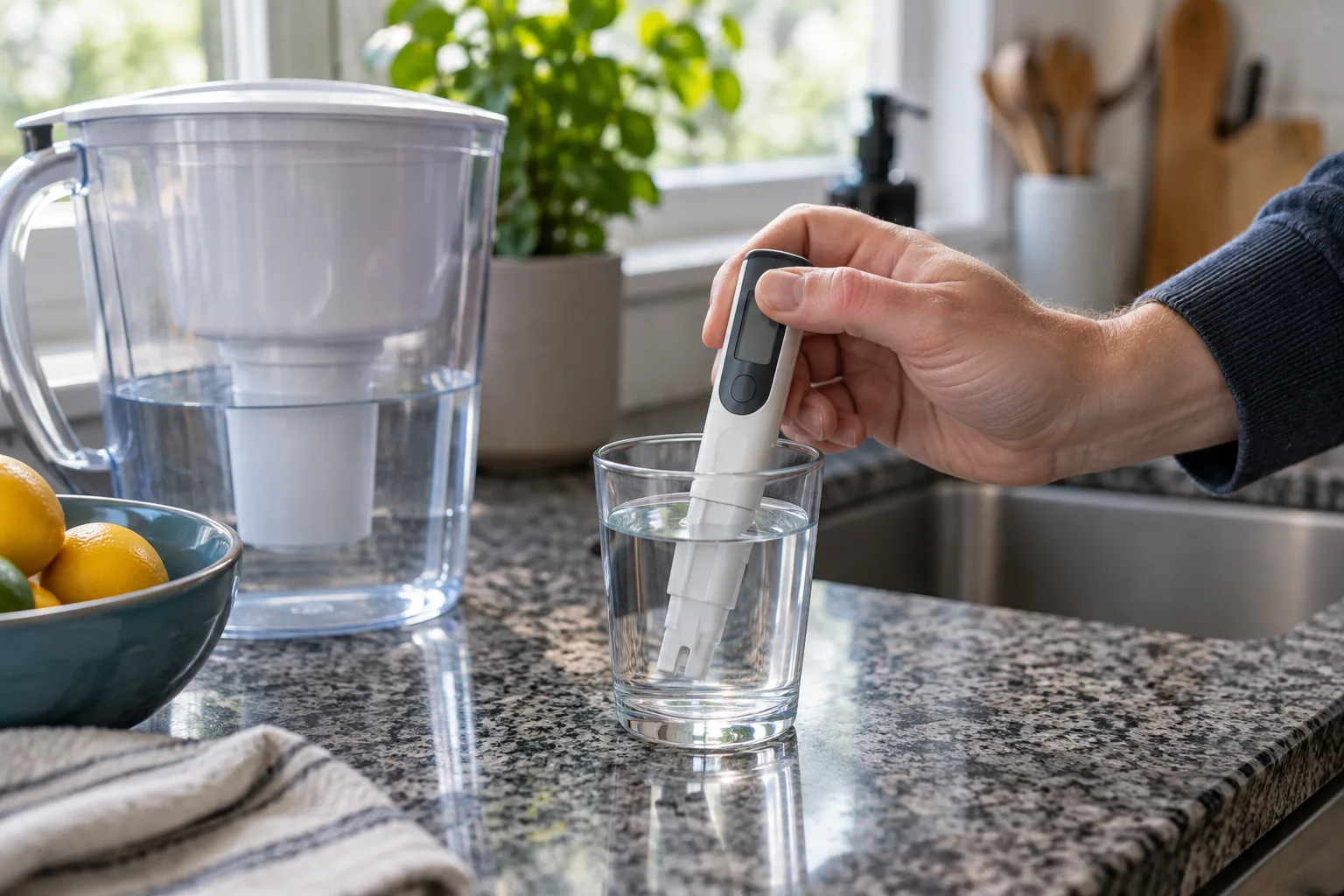
A small handheld meter reading total dissolved solids has become a popular way to test a filter, usually by measuring before and after. It does not measure what people think it measures.
A TDS meter measures electrical conductivity and converts it into an estimate of total dissolved minerals. Almost all of that reading, in ordinary tap water, is calcium, magnesium, sodium, bicarbonate and similar. Those are the minerals that make water hard, and the US Environmental Protection Agency classes total dissolved solids as a secondary standard — a matter of taste, appearance and nuisance rather than of health.
Two consequences follow, and they point in opposite directions.
- A high reading is not a warning. Water can be mineral-rich, taste flat or leave scale, and still meet every health-based standard that applies to it. What that reading is actually telling you about is hardness, which we cover in hard water, soft water and what each does around the house.
- A low reading is not a clean bill of health. The contaminants with health-based limits are present at concentrations far too small to shift a conductivity reading. A meter cannot see them. Lead at a level the EPA considers actionable would not move the needle at all.
So a filter that barely changes a TDS reading may be reducing exactly what you wanted it to reduce, and a filter that drops the reading sharply has mostly removed minerals that were never a health concern. The meter is answering a question about taste and scale. It is silent on the question people buy it to answer.
A handheld meter measures the minerals that were never the problem, and cannot see the contaminants that are.
Where this leaves lead
Lead is worth singling out because it is the contaminant most often raised about jug filters, and because it behaves in more than one way.
As the EPA explains, lead in drinking water generally comes from the plumbing between the main and the tap rather than from the source water — lead service lines, lead solder, and brass fittings. It can arrive as dissolved lead or as small particles shed from corroding pipework.
Those two forms need different handling. Particulate lead can be caught by a sufficiently fine physical barrier. Dissolved lead cannot, and needs adsorption or ion exchange — the same constraint that governs the fluorinated industrial compounds known as PFAS, which dissolve completely and cannot be strained out at any pore size. A unit certified for lead reduction has been tested against the forms the standard specifies; a filter that merely contains carbon has not been tested against anything in particular. The presence of the right material is not evidence of the right result.
What a jug is actually good for
None of this makes jug filters bad. It makes them a specific tool with a specific job, and the job is one they do well.
- Chlorine taste and odour. This is the thing most people actually dislike about their tap water, and a jug handles it cheaply and effectively.
- No installation. Renting, or unwilling to touch the plumbing, is a real constraint and a jug respects it.
- Low commitment. A few pounds or dollars a month against a plumbed installation.
What a jug is not is a barrier you should rely on against a health-based contaminant that your water actually contains, unless that specific unit carries certification for that specific contaminant.
How to decide sensibly
Read your supplier's published water quality report first. It names what is in your water and at what concentration, measured locally, and it costs nothing.
If the answer is that the water meets every health-based standard and you simply dislike the taste, a jug is the proportionate answer and a plumbed system is overkill. If the report or your plumbing suggests a specific contaminant, the question becomes whether a given unit is certified to reduce that contaminant at the flow rate you will actually use it at — and for most contaminants of that kind, the honest answer for a gravity jug is no.
Sources
Every figure in this guide traces to one of the documents below.
- US Centers for Disease Control and Prevention Water Filters cdc.gov Government / academic
- US Centers for Disease Control and Prevention About Home Water Treatment Systems cdc.gov Government / academic
- US Environmental Protection Agency Secondary Drinking Water Standards: Guidance for Nuisance Chemicals epa.gov Government / academic
- US Environmental Protection Agency Basic Information about Lead in Drinking Water epa.gov Government / academic