Water Softeners: What the Resin Beads Actually Do
A water softener is an ion-exchange machine, not a filter. This explains what happens inside the resin tank, why the thing needs a sack of salt, and what softened water contains that hard water did not.
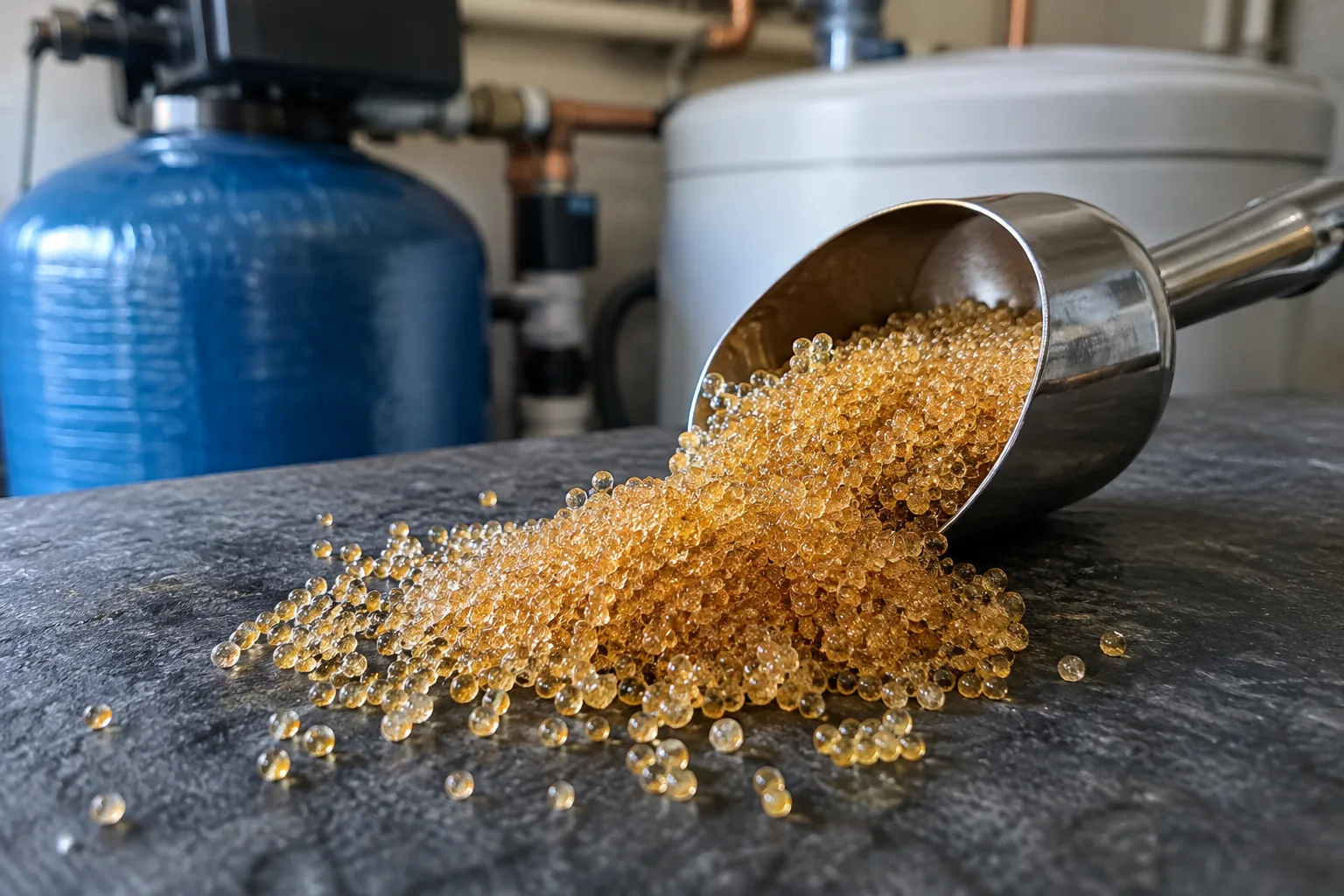
A softener trades the calcium and magnesium that build limescale for sodium, held on a column of resin beads that has to be flushed with salt water to keep working.
✓ 5-Second Summary & Core Facts
- Hardness is dissolved calcium and magnesium, measured in milligrams per litre of calcium carbonate.
- The US Geological Survey calls water soft below 60 mg/L and very hard above 180 mg/L.
- Inside the softener is a column of small resin beads that hold sodium loosely and grab calcium and magnesium more tightly.
- The salt is not going into your water to soften it; strong brine is used to strip the trapped hardness off the beads and flush it to the drain.
- A softener removes hardness, not contaminants — it is a different job from a carbon block or a membrane.
- Softened water carries sodium in place of the calcium and magnesium it started with, roughly in proportion to how hard the water was.
A water softener does not clean your water. It swaps one set of minerals for another: the calcium and magnesium that make water hard are pulled out and held inside the unit, and sodium goes into the water in their place.
That single swap is the whole machine. The cylinder, the sack of salt, the hose running to a drain and the cycle that clicks on in the middle of the night all exist to keep that swap going. Here is what is physically happening at each step.
What "hard" water actually is
Hardness is dissolved rock. The US Geological Survey (USGS), the American government's earth science agency, describes hard water as water that has picked up calcium and magnesium as it moved through rock such as limestone or chalk, and it is usually reported as milligrams per litre of calcium carbonate.
The USGS puts numbers on the words. Water up to 60 mg/L of calcium carbonate is soft; 61 to 120 mg/L is moderately hard; 121 to 180 mg/L is hard; anything above 180 mg/L is very hard. So "hard water" is not a feeling about your kettle — it is a measurement, and there is a figure for the water coming into your house.
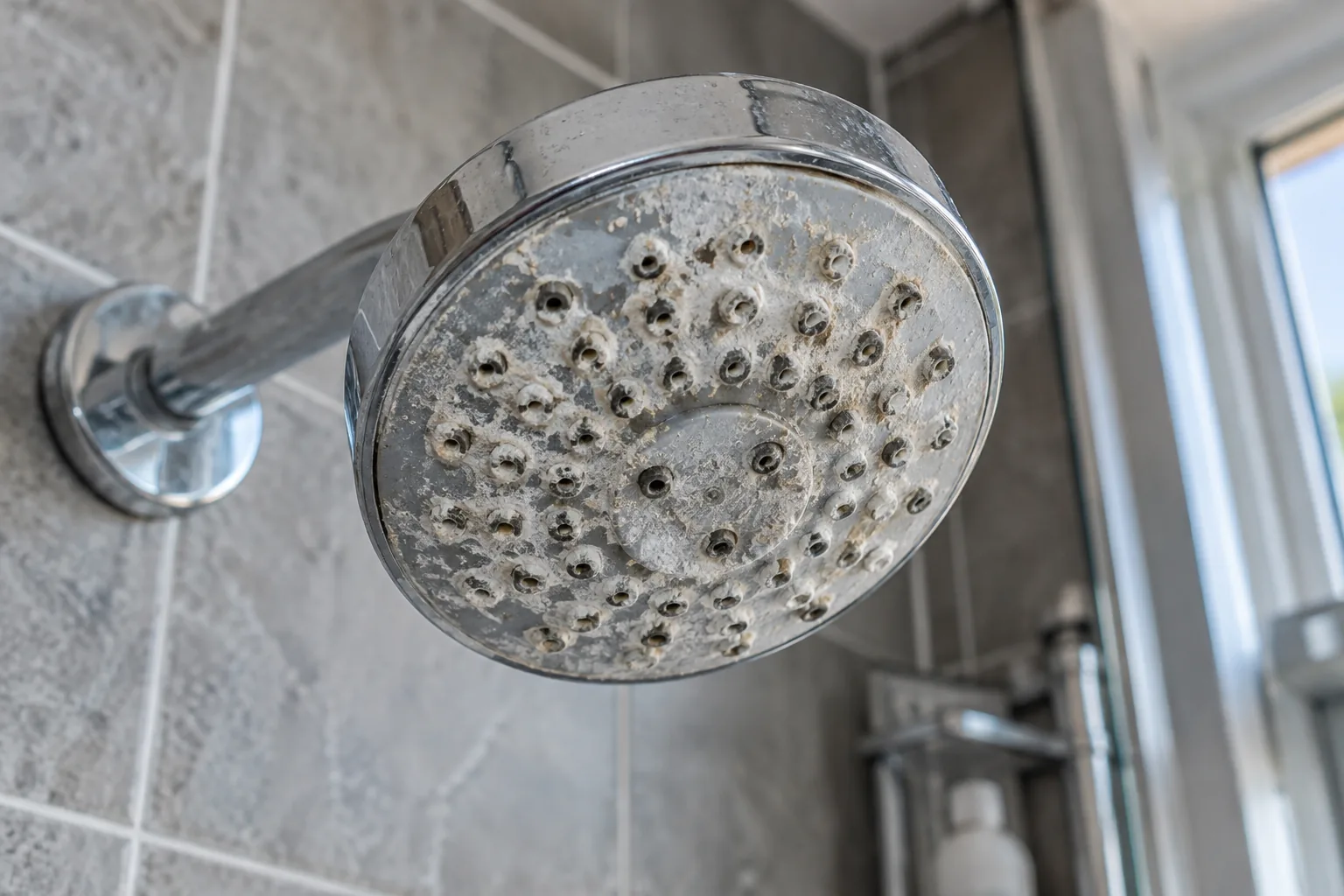
Those same two minerals are what leaves the chalky crust behind. Heat the water, and calcium carbonate comes out of solution and sticks to whatever is hot: the element in a kettle, the inside of a boiler, the nozzles on a shower head. If you want the longer version of what calcium and magnesium do in the pipes and on the glassware, there is a separate piece on what those minerals actually do.
Inside the tank: a column of tiny beads
Open the tall cylinder of a softener and there is no filter in there — no paper, no fabric, no cartridge. It is packed with resin beads, small round plastic beads roughly the size of coarse sand grains.
Each bead has a fixed negative charge built into it, and that charge holds positively charged ions loosely on the surface. When the softener is fresh, what it is holding is sodium. The USGS describes softening as cation exchange — "cation" just means a positively charged particle — in which the hardness minerals, calcium and magnesium, are exchanged for sodium or potassium ions.
The reason the swap goes one way is that calcium and magnesium each carry a double positive charge, and the beads hold them more tightly than they hold single-charged sodium. So as your water trickles down through the column, the calcium and magnesium stick to the beads and shove the sodium off, and the water that leaves the bottom of the tank has sodium in it where the hardness used to be. Nothing has been strained out. The hardness is still in the house — it is sitting on the beads.
Why there is a sack of salt next to it
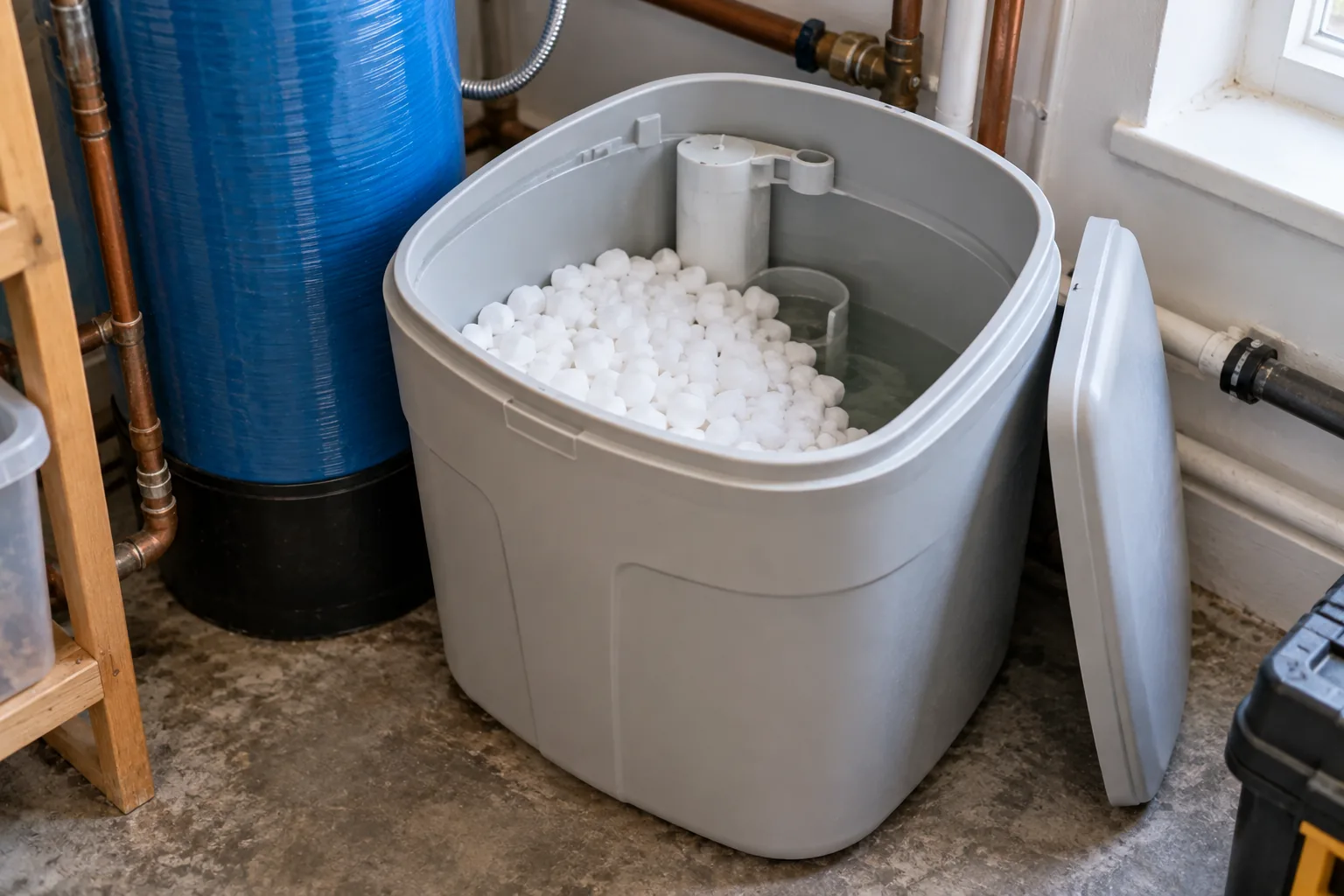
The beads fill up. Every litre that goes through leaves a little more calcium and magnesium stuck to the resin and takes a little more sodium away, and eventually there is nothing loosely held left to trade. At that point the softener has to be regenerated, and that is what the salt is for.
Regeneration floods the resin with a very strong salt solution — brine — drawn from the second, squatter tank. Individually, sodium loses the tug of war with calcium. In overwhelming numbers it wins it: the sheer concentration of sodium ions forces the calcium and magnesium off the beads, and the rinse carries them out through the drain hose. The beads end up loaded with sodium again and the cycle starts over.
So the salt is not sweetening your water or dissolving scale. It is the reset button. The hardness that came out of your water leaves the house as waste water during that flush, which is why a softener needs a drain connection at all.
A softener is not a filter, and the difference matters
This is the part that gets muddled most often, because both sit on a pipe and both are sold as water treatment. An ion exchange softener is built to trade two specific minerals. It is not designed to hold back lead, chlorine taste, or the large family of man-made fluorinated compounds known as PFAS (per- and polyfluoroalkyl substances).
Those jobs belong to different mechanisms: a carbon block works by adsorption onto a huge internal surface area, and a reverse osmosis membrane works by pressure across a barrier. A house can have a softener and still have every other question about its water completely untouched.
What softened water has in it that hard water did not
Sodium, in place of the calcium and magnesium. That is not a side effect — it is the exchange, and it is roughly proportional: the harder the water going in, the more sodium comes out the other side, because more hardness had to be traded away.
Two practical consequences fall out of that. First, some softeners are run on potassium chloride instead of sodium chloride, which does the same exchange with potassium as the loosely held ion. Second, because a softener sits on the incoming main, everything downstream of it is softened — so installations commonly take a branch off the pipe for the kitchen cold tap before the water reaches the unit, leaving that one tap on the original hard supply.
Hardness is not a health-based limit
It is worth being clear about where hardness sits in the rules, because it sits in an unusual place: mostly outside them. The US Environmental Protection Agency (EPA) splits drinking water standards into primary standards, which are enforceable and health-based, and secondary standards, which are non-enforceable guidelines covering nuisance qualities — taste, colour, staining. The secondary list includes total dissolved solids at 500 mg/L, iron at 0.3 mg/L and chloride at 250 mg/L.
Hardness itself is not on either list. It is treated as a question about your appliances and your plumbing rather than a contaminant with a number attached to it.
How to find out how hard your water actually is
You do not have to guess, and you do not have to buy anything to find out. Water suppliers publish quality data for the area they serve, and hardness is one of the figures that appears in it, usually as milligrams per litre of calcium carbonate — the same scale the USGS classification above uses, so you can read your number straight against it.
If you want to know what those reports cover, what they leave out, and when a lab test tells you something the report cannot, that is set out in the piece on the free report and the lab test. Start with the number for your postcode. Everything about whether an ion exchange column would do anything noticeable in your house follows from it.
Sources
Every figure in this guide traces to one of the documents below.
- US Geological Survey Hardness of Water usgs.gov Government / academic
- US Environmental Protection Agency Secondary Drinking Water Standards: Guidance for Nuisance Chemicals epa.gov Government / academic
- US Environmental Protection Agency Drinking Water Regulations and Contaminants epa.gov Government / academic
- World Health Organization Drinking-water who.int Government / academic