Limescale: What the White Crust Actually Is
Limescale is calcium carbonate left behind when hard water is heated or dries out. This explains where the minerals come from, why the kettle and the shower head get it first, how hardness is measured, and what physically removes scale or stops it forming.
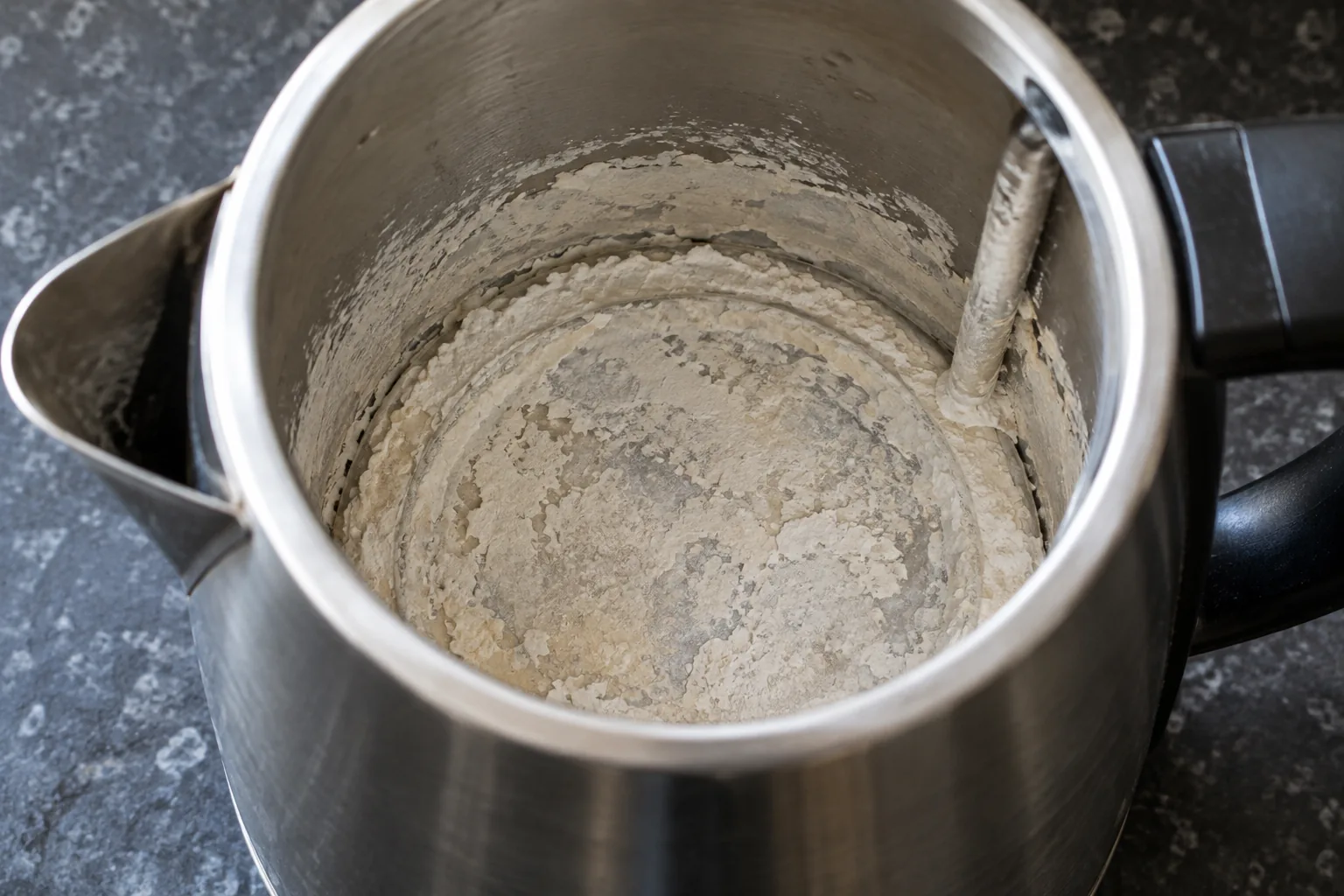
Limescale is the chalk-like mineral deposit hard water leaves when it is heated or evaporates — an appliance and plumbing nuisance rather than a regulated contaminant.
✓ 5-Second Summary & Core Facts
- Limescale is mostly calcium carbonate, the same mineral as chalk, dissolved out of rock before the water reached your home.
- It builds up on hot surfaces first because the minerals come out of the water as it heats, not as it cools.
- The US Geological Survey classes water as hard from 121 mg/L of calcium carbonate upward, and very hard above 180 mg/L.
- The World Health Organization sets no health-based guideline value for hardness and treats it as a matter of acceptability — taste and scale.
- Scale is dissolved by mild acid, not scrubbed off; preventing it means taking the calcium and magnesium out of the water first.
Limescale is the chalky off-white crust hard water leaves behind when it is heated or allowed to dry out, and it is mostly calcium carbonate — the same mineral as chalk and eggshell. It is not dirt, it is not a sign that anything has gone wrong with the supply, and it did not come from the pipes: it came from the rock the water travelled through before it ever reached your street.
Where the minerals come from
Rain lands almost mineral-free. What happens next depends entirely on what it soaks through. Water moving through chalk, limestone or dolomite picks up calcium and magnesium on the way, because those rocks dissolve very slowly in slightly acidic rainwater. Water running off granite or gritstone uplands picks up very little, so it stays soft. That is why hardness is a map rather than a judgement on a water company — two towns forty miles apart can have completely different water out of identical treatment works, and both are entirely within the rules.
Those dissolved minerals are what the word hardness means. If you want the longer version of what they do in a house and on your skin, there is a fuller piece on what the minerals in hard and soft water actually do. For limescale, only one part matters: calcium and magnesium are dissolved in the water as it arrives, and limescale is those same minerals after they have stopped being dissolved.
Why the kettle gets it and the cold tap doesn't
This is the part that surprises people. Most things dissolve better in hot water — sugar, salt, washing powder. Calcium carbonate does the opposite. As water warms, the carbonate becomes less able to stay in solution, and heating also drives off the dissolved carbon dioxide that was holding the calcium in a dissolved form in the first place. Take the carbon dioxide away and the calcium has nowhere to go but onto the nearest hot surface.
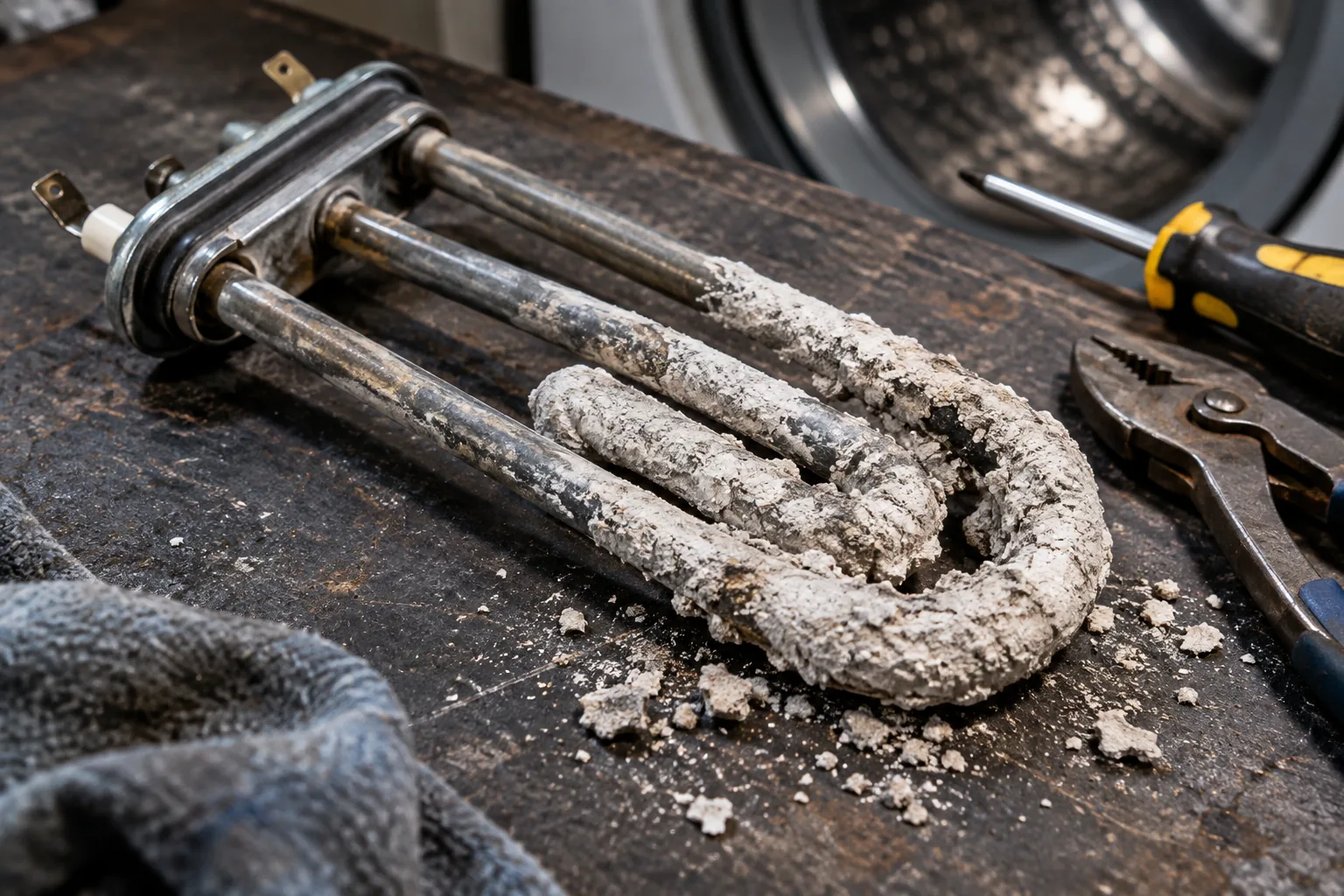
So scale forms where water is hottest and where it sits longest: the element in the bottom of a kettle, the inside of a boiler's heat exchanger, an immersion heater, the heating element in a washing machine or dishwasher. The World Health Organization's Guidelines for Drinking-water Quality describe exactly this nuisance — scale deposition in heating systems, pipework and tanks — as one of the practical consequences of hard water.
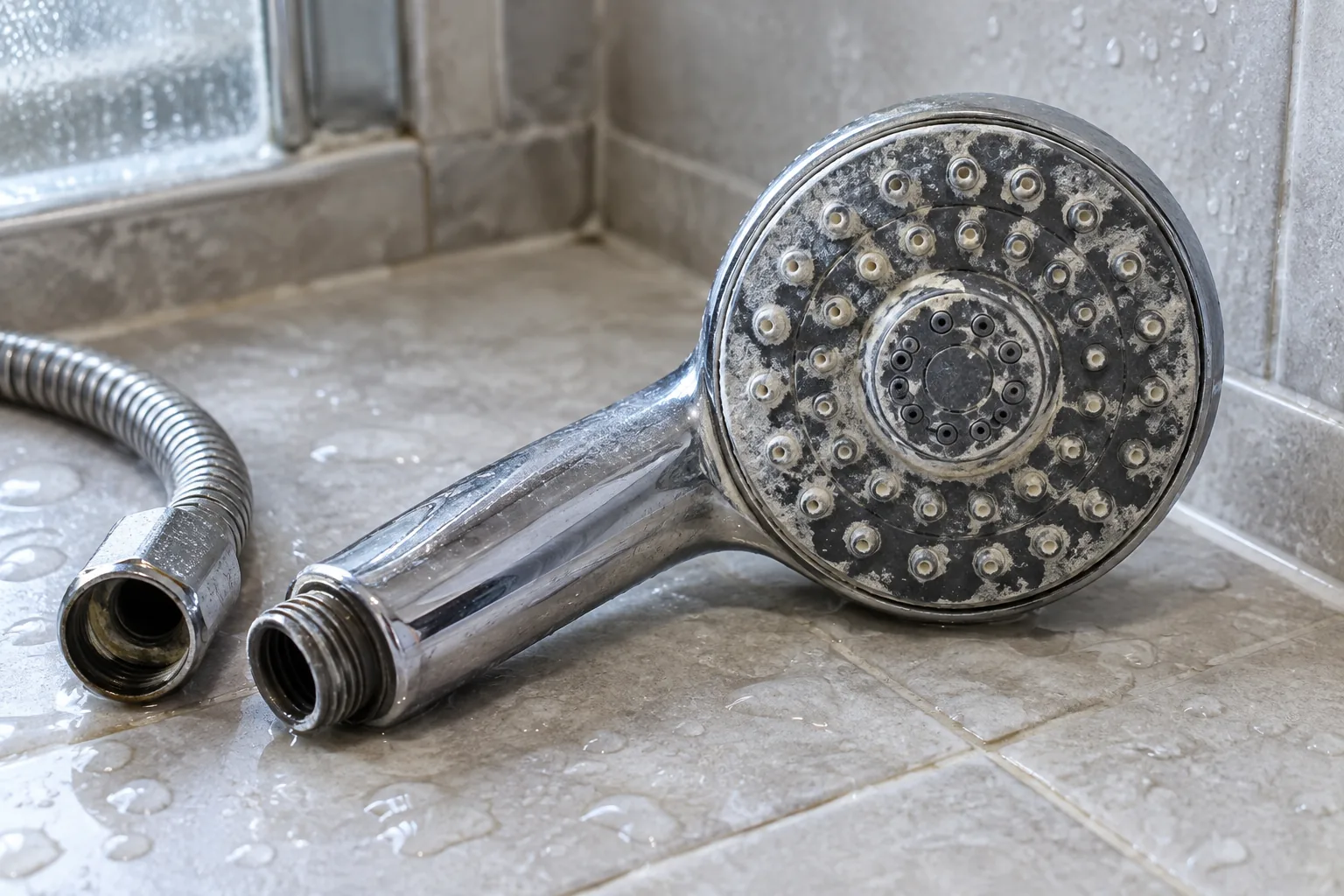
The second place scale appears has nothing to do with heat. Where water evaporates, the minerals are left behind in the same way, which is why shower head nozzles fur up, why a kitchen tap spout gets a rim of white, and why glassware dries with spots. Nothing has concentrated the water; the water simply left and the calcium stayed.
How hardness is measured, and what counts as hard
Hardness is almost always reported in milligrams per litre (mg/L) of calcium carbonate, which is the same number as parts per million (ppm). The US Geological Survey classifies water as soft up to 60 mg/L, moderately hard from 61 to 120, hard from 121 to 180, and very hard above 180 mg/L of calcium carbonate — roughly 7 to 10.5 grains per gallon for the hard band, in the older units some US reports still use. British water companies publish the same figure, sometimes alongside Clark degrees or German degrees, which are just different arithmetic on the same measurement.
You do not need a test kit to find your number. Your water supplier publishes hardness by postcode or zip code, usually free, and that report is the right place to start before buying anything at all — the free report and when a lab test adds something covers what each one can and cannot tell you.
Is limescale regulated?
Not as a safety limit, and this is where it differs from most things this site covers. The World Health Organization does not set a health-based guideline value for hardness in drinking water; it is handled under acceptability, meaning taste and the practical problems scale causes. In the United States, the Environmental Protection Agency's Secondary Drinking Water Standards — a set of non-enforceable guidelines covering taste, colour and odour rather than health — contain no figure for hardness at all. The closest entry is total dissolved solids, the combined weight of everything dissolved in the water, with a secondary standard of 500 mg/L.
So when a water report shows hardness of 280 mg/L, nothing has been exceeded. It is a description of the water, in the same way a report might describe its pH.
What actually removes scale once it is there
Scale is dissolved, not scrubbed. Calcium carbonate reacts with mild acid, which is why a weak acid left to sit on a descaling job does in twenty minutes what an hour of scouring will not: the crust is converted to something soluble and simply rinses away. Scouring a heating element or a tap finish, by contrast, mostly damages the element or the finish while the scale stays in the pits where it is thickest.
Hot appliances are where it is worth the bother, because scale is a poor conductor of heat. A furred element has to run hotter to push the same warmth into the water around it, and the crust keeps thickening in the hottest spot. Appliance manuals set descaling intervals by hardness band for exactly that reason.
What stops it forming at all
Only one thing does: removing the calcium and magnesium before the water is heated. The standard mechanism is ion exchange. Water is passed through a bed of small plastic resin beads carrying loosely held sodium ions; calcium and magnesium stick to the beads more strongly than sodium does, so they swap places and the water that leaves carries sodium instead of the scale-forming minerals. When the beads are full, a strong salt solution floods them and reverses the swap. That mechanism is covered properly in what the resin beads actually do.
Two things worth knowing about the alternatives, in mechanism terms. A carbon filter does not touch hardness — carbon works by adsorbing organic molecules onto a huge internal surface area, and dissolved calcium is not an organic molecule, so it passes straight through. A reverse osmosis membrane does reject dissolved minerals, but it is normally fitted to one cold tap and runs slowly, so it changes what is in a glass rather than what reaches a boiler or a washing machine.
And a sentence that is easy to miss: softened or filtered water does not remove the scale already sitting in a system. It stops adding to it. Existing deposits still have to be dissolved out, or left where they are.
The short version
Limescale is the dissolved rock in your water becoming solid rock again at the moment the water is heated or evaporates. The amount you get is set by the geology upstream of your tap, it is measured in milligrams per litre of calcium carbonate on a report you can read for free, no regulator treats it as a limit to be met, and the only two useful responses are a mild acid for what has already formed and taking the minerals out before the water is heated for what has not.
Sources
Every figure in this guide traces to one of the documents below.
- US Geological Survey Hardness of Water usgs.gov Government / academic
- US Environmental Protection Agency Secondary Drinking Water Standards: Guidance for Nuisance Chemicals epa.gov Government / academic
- World Health Organization Guidelines for Drinking-water Quality: Fourth Edition Incorporating the First Addendum who.int Government / academic