Scale in Boilers: Why the Hottest Metal Furs Up First
What the hard crust inside a boiler actually is, why heat is what makes it form, which parts of a heating system it lands on, and why the hardness of your supply decides whether you ever see it.
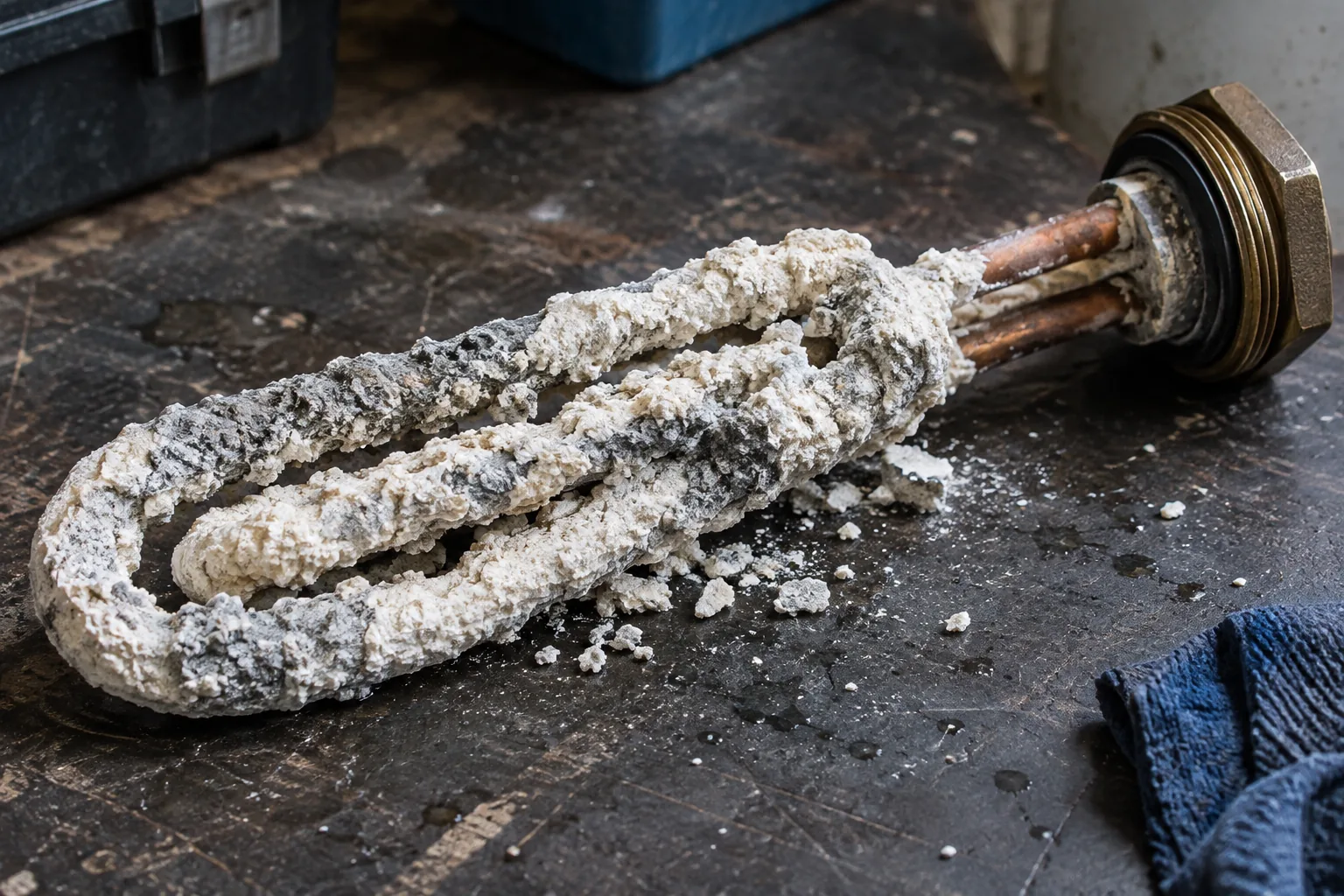
Boiler scale is limescale from hard water, it grows fastest on the hottest metal in the system, and the only thing that stops it is taking the calcium and magnesium out of the water before it is heated.
✓ 5-Second Summary & Core Facts
- Scale is calcium carbonate that came out of the water, not dirt that came in with it.
- Heat is the trigger: the hotter the surface, the faster the crust forms on it.
- In a combi boiler it builds on the hot-water side, which sees fresh mains water every time a tap is opened.
- The US Geological Survey calls water above 180 mg per litre as calcium carbonate 'very hard'; that figure is on your supplier's report.
- A kitchen-tap filter does nothing for a boiler, because the boiler is fed from the mains upstream of it.
- Ion exchange softening removes the calcium and magnesium before heating, which is the only point at which scale can be prevented rather than scraped off.
Scale in a boiler is limescale: a hard, chalky layer of calcium carbonate sitting on the hottest metal inside the heating system. It forms because the calcium and magnesium dissolved in hard water will not stay dissolved once the water is heated, so they come out of the water and settle on whatever surface is hottest.
That is the short answer. What follows is where it lands, why one house gets a furred-up boiler in three years and another never does, and what actually changes it.
What is in the water before it ever reaches the boiler
Hard water is ordinary water carrying dissolved minerals it picked up underground, mostly calcium and magnesium from chalk and limestone. You cannot see them, they do not settle out in a glass, and nothing is wrong with the water for containing them. Hardness is measured as milligrams per litre of calcium carbonate, which is just a common scale so that different supplies can be compared.
The US Geological Survey sorts supplies into four bands using that measure: 0 to 60 mg per litre is soft, 61 to 120 is moderately hard, 121 to 180 is hard, and anything above 180 mg per litre is very hard. Two houses an hour apart can sit in different bands, because the number depends on the rock the water moved through, not on the plumbing. If you want the full picture of what those minerals are and what they do elsewhere in the house, that is covered in what the white crust actually is.
Why heat is the trigger
Most solids dissolve more readily in hot water than cold. Calcium carbonate works the other way round, which is the single fact that explains every scaled boiler, kettle and immersion heater. Warm the water and some of the calcium stops being dissolved and becomes solid again, and it does that first and fastest against the hottest surface it is touching.
The World Health Organization's drinking-water guidelines describe scale deposition as a practical effect of hard supplies, and put the point at which it becomes noticeable at around 200 mg per litre as calcium carbonate. WHO has not set a health-based guideline value for hardness at all; in the guidelines it is handled as a matter of taste and of deposits in pipes and appliances.
So the crust is not something that arrived in the water. It is something the water was carrying all along, parked on your heat exchanger by the act of heating it.
Which part of the system actually furs up
This is where it gets specific, and where a lot of general advice about hard water stops being useful.
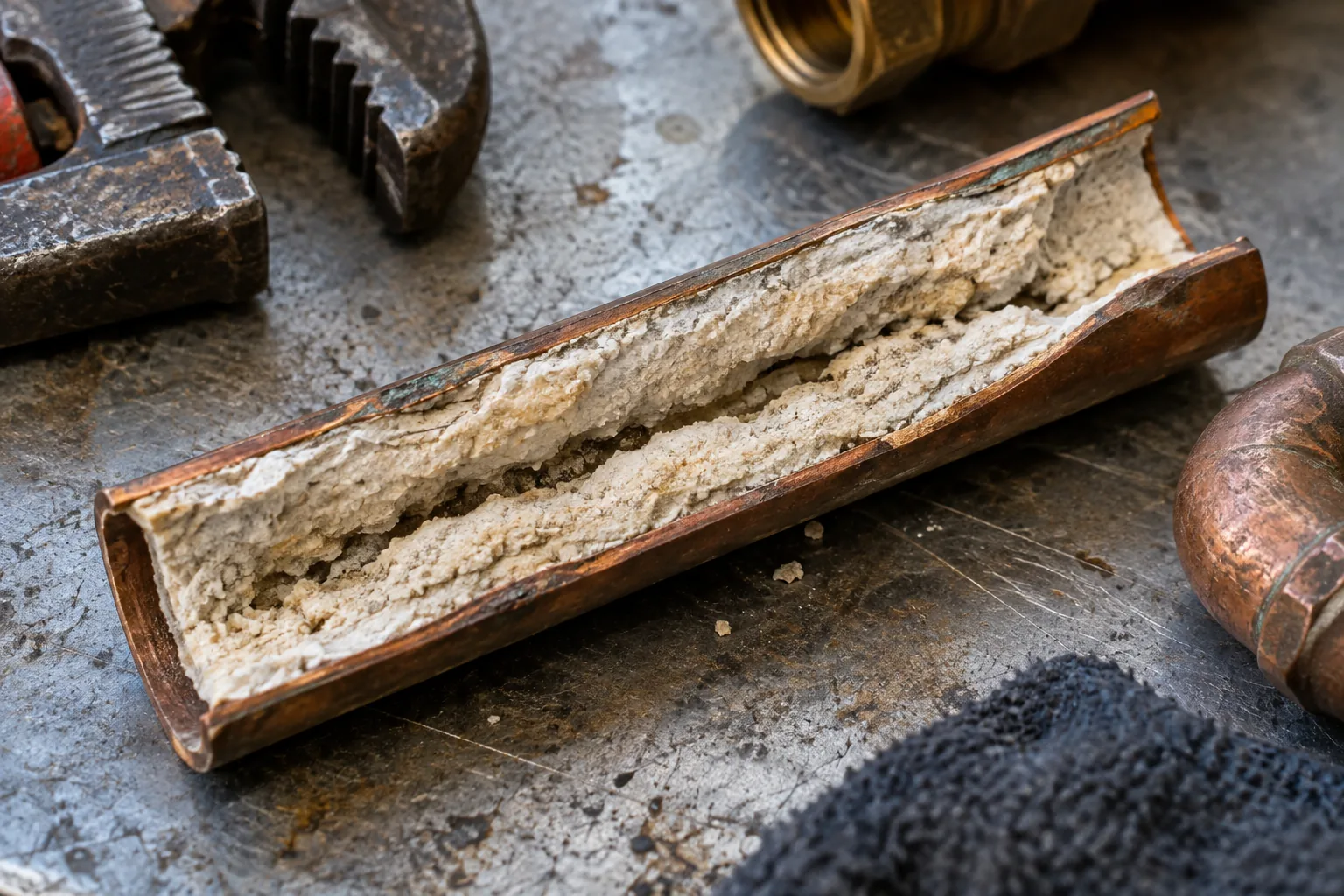
- A combi boiler's hot-water side. When you open a hot tap, a combi takes cold mains water and heats it hard and fast as it passes through a heat exchanger with very narrow waterways. Every litre of that water is fresh, and every litre brings its full load of calcium with it. That is the surface that scales.
- The central heating side. Radiators and the pipework feeding them are a sealed loop. The same water goes round and round, so whatever hardness it started with is deposited once and then there is no more coming. This is why radiators can be full of sludge and still have almost no scale in them.
- An immersion heater in a hot water cylinder. The element is the hottest thing in the tank, so it furs up exactly like the element in a kettle, in a thick grey-white shell.
The pattern is consistent: scale collects where the water is hottest and where fresh hard water keeps arriving. Anywhere that fails one of those two conditions stays comparatively clean.
What the crust does to the way a boiler behaves
Scale sits between the heat and the water, so the heat has to cross it before it reaches anything useful. The metal underneath therefore runs hotter than it would with clean water against it, while the water takes longer to pick that heat up.
In narrow waterways there is a second effect, which is simply plumbing: a layer of solid mineral growing inward from the walls leaves less room for water to pass through. The knocking, rumbling or kettle-like noise some boilers develop comes from this part of the system, where water is being heated in a channel that is no longer the shape it was built as.
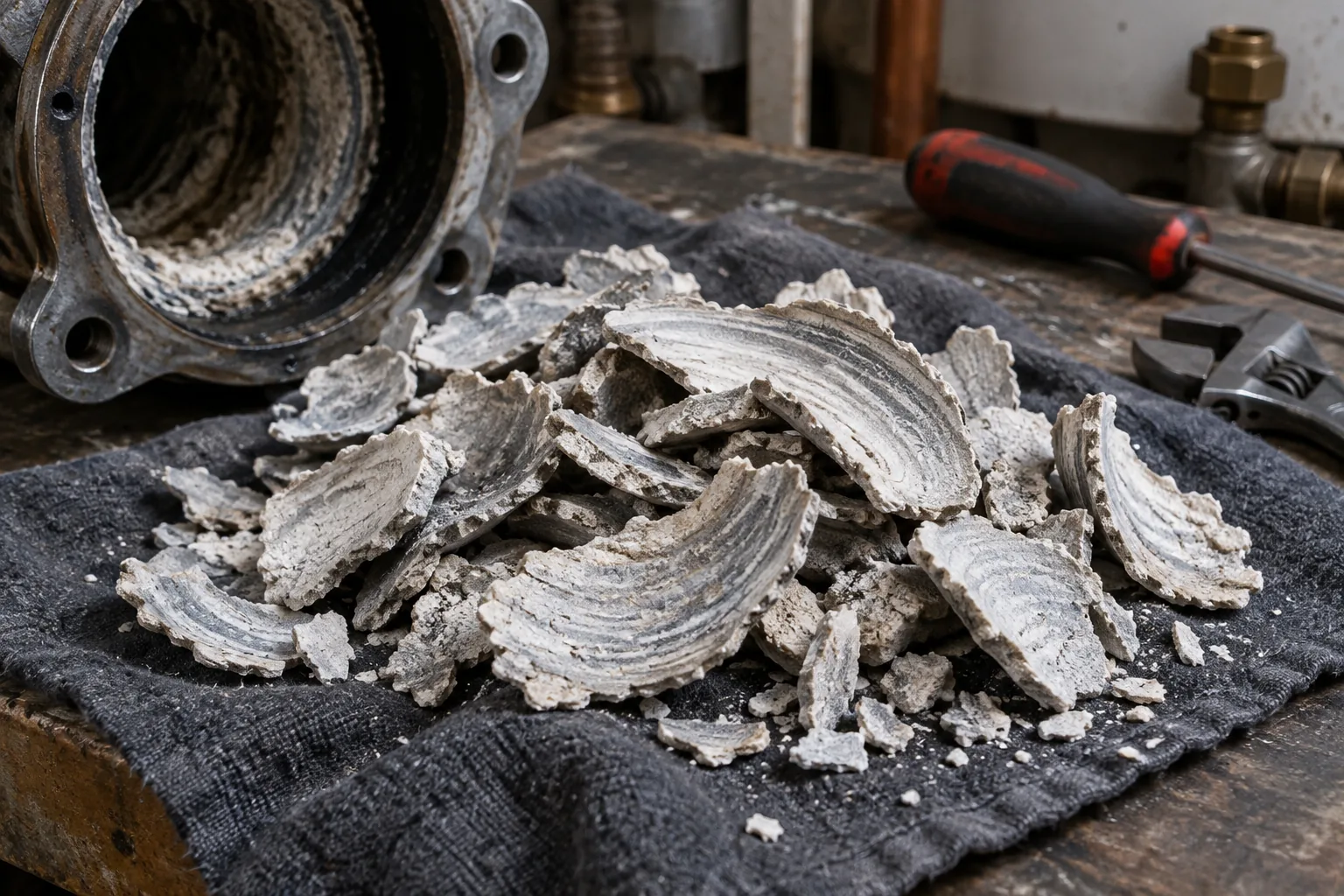
None of that happens quickly. It happens over years, at a speed set almost entirely by how hard the incoming water is and how hot the system runs.
Why some homes get it and others never do
Hardness is a local fact, and you can look yours up rather than guess at it. Water suppliers publish the hardness of each supply zone, usually in milligrams per litre as calcium carbonate, sometimes in older units like grains per gallon or degrees Clark. Comparing that number against the US Geological Survey bands above tells you most of what you need to know about whether scale is a live issue in your house. The free supplier report and what a lab test adds goes through where to find it.
It is worth knowing that hardness is not a regulated contaminant in the way lead or nitrate are. The US Environmental Protection Agency keeps a separate set of secondary drinking water standards, which are non-enforceable guidelines covering things that affect taste, colour, odour and appearance rather than anything the agency enforces on a supplier. Total dissolved solids, the broad measure that includes dissolved calcium and magnesium, sits on that list at 500 mg per litre. Hardness itself is not on the list at all.
What actually prevents it
Only one thing prevents scale, and it is removing the calcium and magnesium before the water is heated. That is what an ion exchange softener does: the water passes through a tank of small plastic resin beads that hold onto calcium and magnesium and release sodium in their place, so the water arriving at the boiler has very little left in it to deposit. What the resin beads actually do explains the swap and what it costs you in salt and in wastewater.
Two things that do not prevent it, and are often assumed to:
- A filter at the kitchen tap. A jug, an under-sink cartridge or a tap-mounted unit treats the water going into your glass. Your boiler is fed from the mains well upstream of all of them, so it never sees that water. Position matters more than performance here.
- Carbon filtration anywhere. Carbon works by adsorption, holding organic molecules and chlorine on its enormous internal surface area. Dissolved calcium and magnesium are not held that way, so carbon can improve how water tastes while leaving its hardness unchanged.
Scale that has already formed is a different problem from scale that has not. Calcium carbonate dissolves in acid, which is why descaling a heating system is an acid job done by someone who knows what the components are made of, rather than something to improvise on an appliance full of pressurised water.
The one number to start with
Find the hardness figure for your postcode on your supplier's report. If it is under about 120 mg per litre as calcium carbonate, scale inside the boiler is a slow background process and not much of a story. If it is well above 180, the US Geological Survey's 'very hard' band, then everything above is describing what is happening on the hot side of your heating system right now, at a rate set by your water rather than by your boiler.
Sources
Every figure in this guide traces to one of the documents below.
- US Geological Survey Hardness of Water usgs.gov Government / academic
- US Environmental Protection Agency Secondary Drinking Water Standards: Guidance for Nuisance Chemicals epa.gov Government / academic
- World Health Organization Guidelines for Drinking-water Quality: Fourth Edition Incorporating the First and Second Addenda who.int Government / academic