Hard Water Stains: What They Are and Why Acid Removes Them
Hard water stains are the dissolved minerals your water leaves behind once it evaporates. This explains what the white spots and films are made of, where the minerals come from, what the hardness number on a water report means, and why a mild acid shifts the deposit when scrubbing does not.
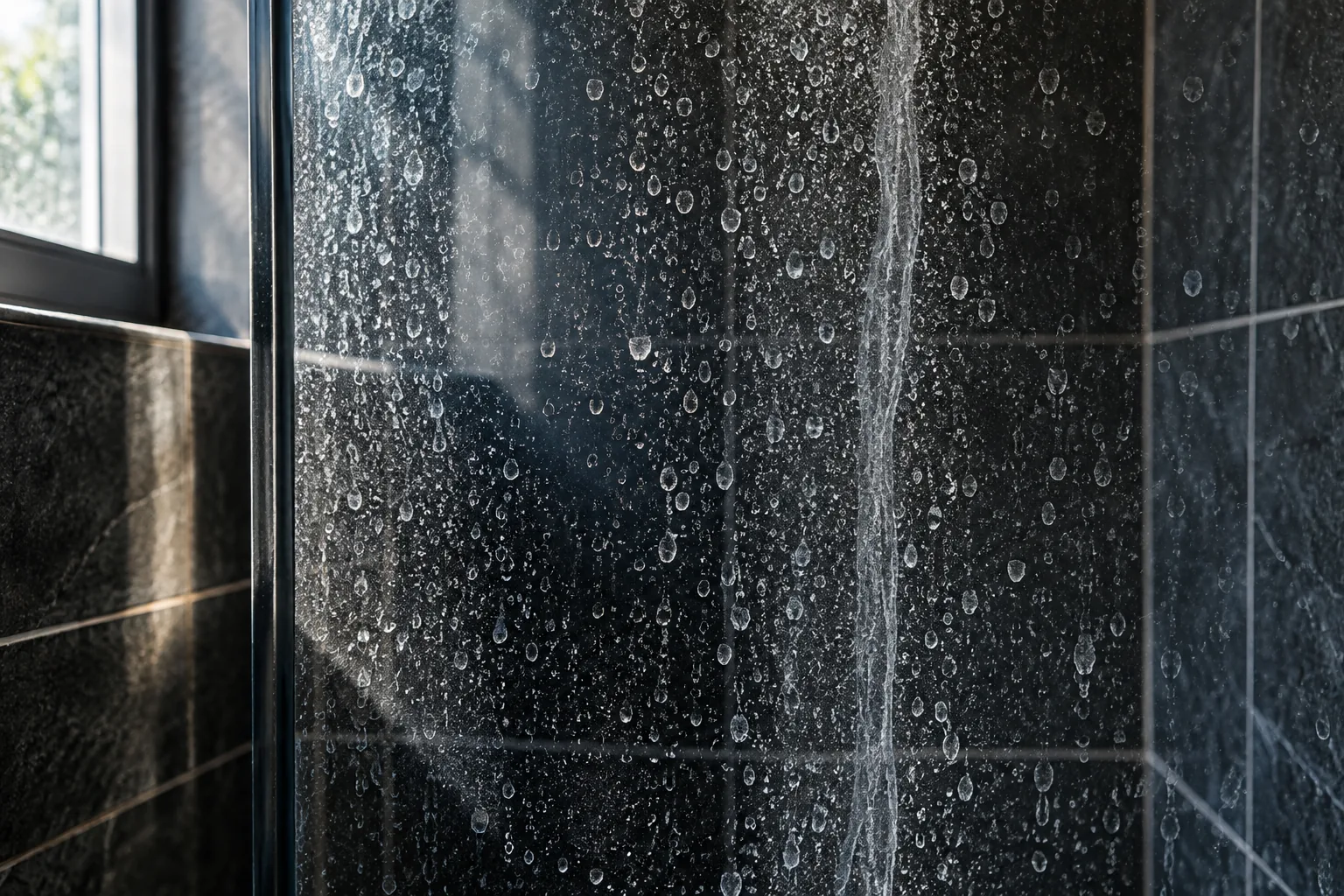
Hard water stains are calcium and magnesium deposits left on the surface after the water itself evaporated, which is why they respond to a mild acid and not to harder scrubbing.
✓ 5-Second Summary & Core Facts
- The white spots are mostly calcium carbonate, the same compound as chalk and limestone, left behind when water dries in place.
- The US Geological Survey calls water hard at 121 to 180 milligrams of calcium carbonate per litre, and very hard above 180.
- Water picks up that calcium and magnesium as rain soaks through soil and rock, so hardness depends on the geology under your supply.
- The US Environmental Protection Agency treats scale and staining as a nuisance issue with non-enforceable guidelines, not a legal limit.
- The World Health Organization sets no health-based guideline value for hardness, and notes scale deposition above roughly 200 milligrams per litre.
- Carbonate barely dissolves in water but reacts with acid, which is why the deposit lifts with a mild acid and survives a scouring pad.
Hard water stains are minerals that were dissolved in your water, sitting on the surface because the water that carried them evaporated and they could not. Mostly they are calcium carbonate, the same compound as chalk and limestone, with magnesium compounds alongside it.
That is the whole mechanism, and it explains nearly everything about them: why they appear where water sits and dries rather than where water runs away, why they come back in exactly the same spots, and why a mild acid shifts them in seconds while a scouring pad and a lot of effort barely touches them.
Why spots, rings and films look so different
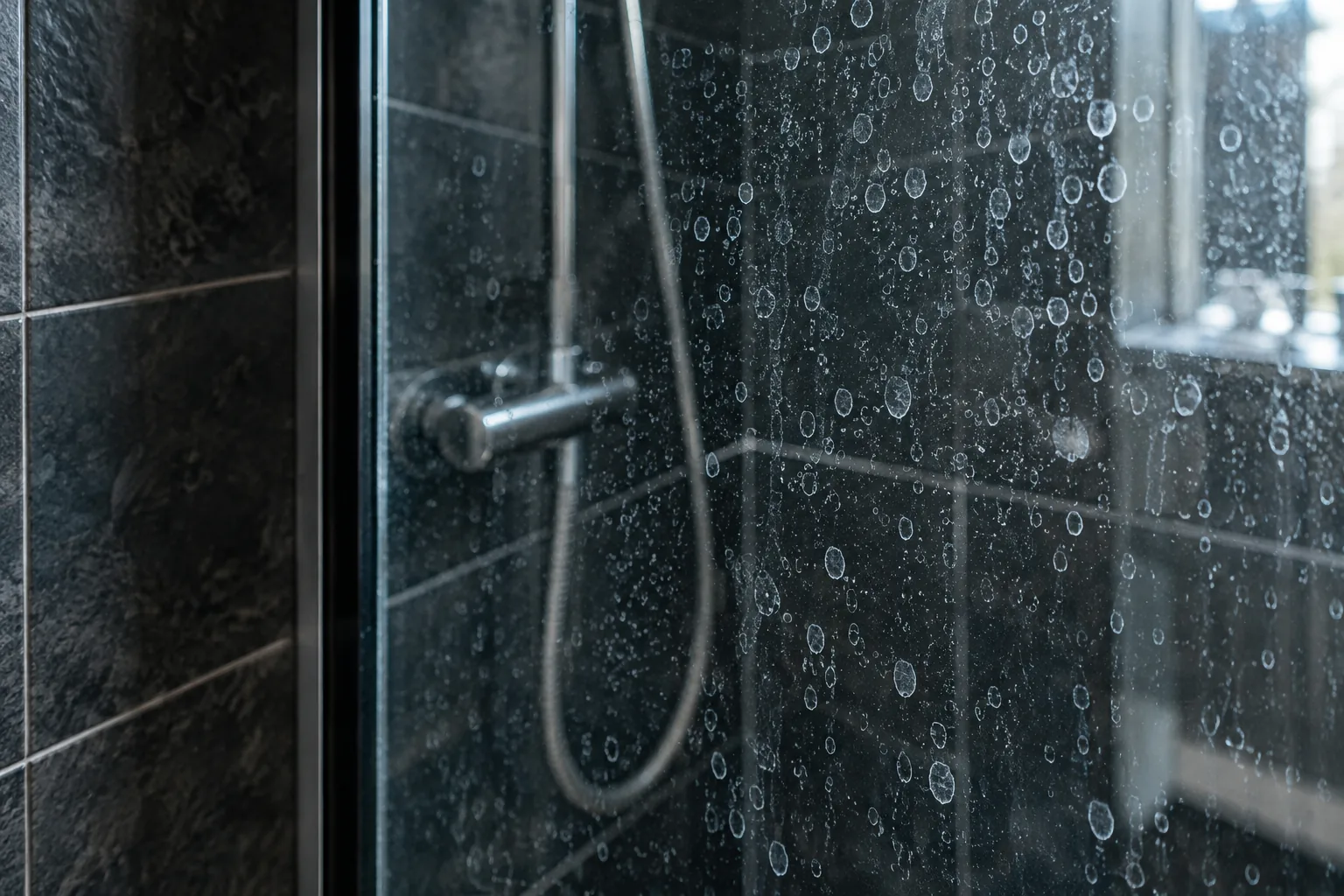
A droplet left on a shower screen dries from the outside inwards. The minerals get carried along with the shrinking edge of the droplet, so most of them end up concentrated in a ring, and you get hundreds of small pale circles. A thin sheet of water that dries all over at once leaves an even haze instead. Water running down a tile in the same track every day leaves a streak that builds up layer on layer until it is thick enough to feel with a fingernail.
None of those are dirt. The surface underneath is clean. What is on top of it is stone, in a very thin form.
Where all that calcium comes from
Rain starts out with almost nothing dissolved in it. It picks up hardness on the way to your tap. The US Geological Survey explains that as water moves through soil and rock it dissolves small amounts of minerals, and calcium and magnesium are the two that make water hard. Chalk and limestone dissolve readily, so a supply drawn from groundwater in limestone country arrives carrying a lot of dissolved calcium, while a supply from a reservoir on granite or peat often carries very little.
This is why staining is a postcode issue rather than a plumbing issue. Two identical showers in two different towns can behave completely differently, and nothing about the shower is the reason.
How hard is hard?
Hardness is usually reported as milligrams of calcium carbonate per litre, written mg/L, which is the same as parts per million. The US Geological Survey groups it like this: soft water is 0 to 60 mg/L, moderately hard is 61 to 120, hard is 121 to 180, and anything above 180 mg/L is very hard. Some reports use grains per gallon instead, which is simply a different unit for the same measurement.
Those numbers are worth knowing because they turn a vague complaint into something you can check. If a report says 230 mg/L, the white marks on the glass are not a mystery and not a sign of anything wrong with the pipes.
Soap scum is a second, different mess
Not every pale smear in a bathroom is a carbonate deposit. Hard water also reacts with soap: the calcium and magnesium combine with the soap itself and form a solid that will not rinse away, which is the grey, slightly waxy film on a bath or a shower tray. It is why soap lathers poorly in hard water, as the US Geological Survey notes, and why more soap often makes the film worse rather than better.
The two messes usually sit on top of each other, which is why a bathroom in a hard water area can look cloudy no matter how often it is cleaned. One is a mineral crust, the other is a soap and mineral residue, and both trace back to the same calcium.
Why nobody sets a legal limit on staining
You will not find hardness in the enforceable part of drinking water rules, and that surprises people. The US Environmental Protection Agency keeps a separate set of secondary standards, which it describes as non-enforceable guidelines for substances that cause cosmetic or aesthetic effects rather than ones it regulates for enforcement. Total dissolved solids sits there with a secondary standard of 500 mg/L, and scale and staining are the kind of effect that list exists to cover.
The World Health Organization takes a similar line in its Guidelines for drinking-water quality: it sets no health-based guideline value for hardness, and notes that water with hardness above roughly 200 mg/L may cause scale deposition, depending on other factors such as pH and alkalinity. So the stains are an acceptability and appearance question by design. That is the reason your supplier will tell you the hardness number if you ask, but will not treat a stained shower screen as a fault.
Why an acid shifts it and scrubbing does not
Calcium carbonate hardly dissolves in plain water. That is precisely why it was left behind when the water evaporated, and it is also why rinsing a spotted panel with more water does nothing: the water leaves again and takes nothing with it.
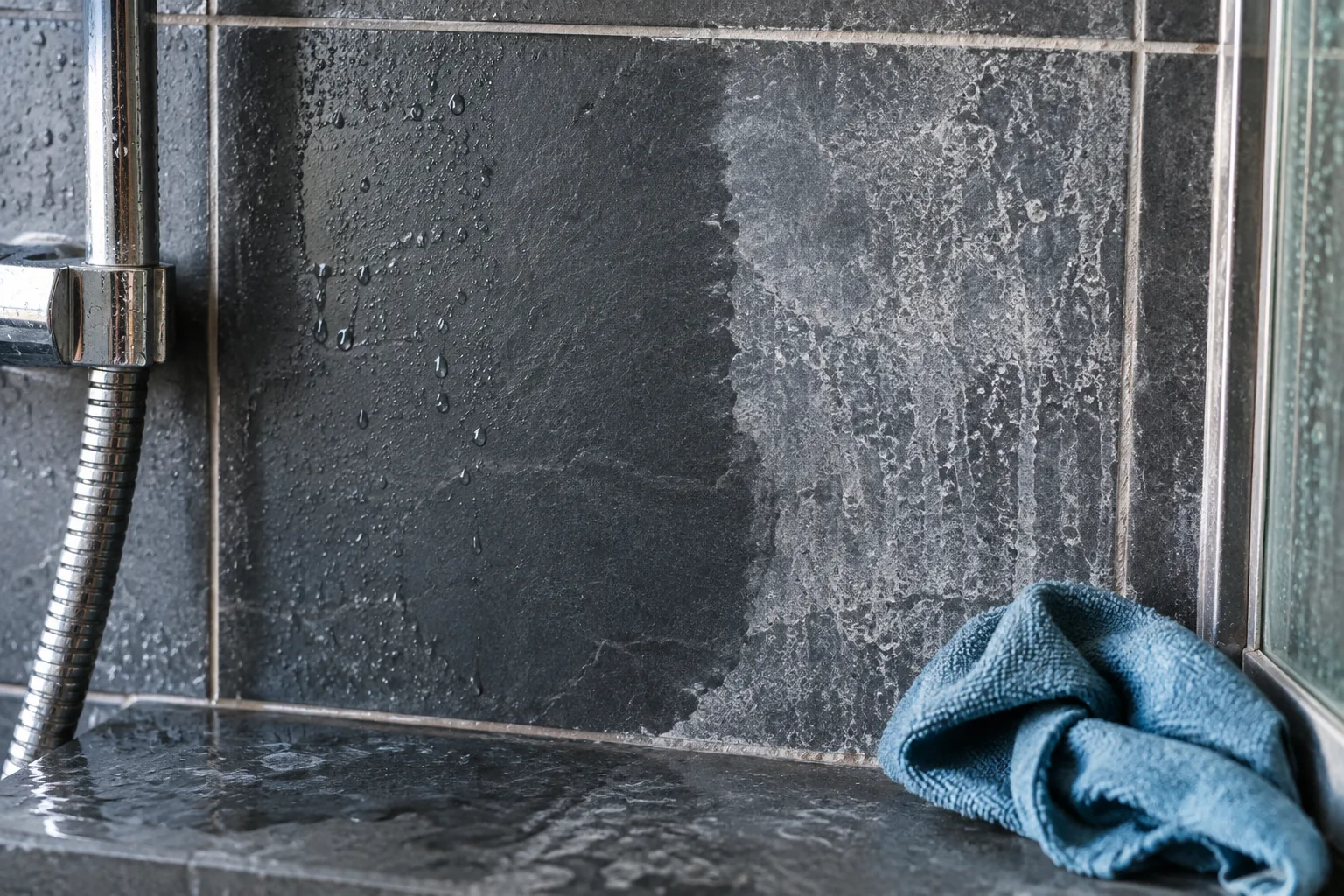
Carbonate does, however, react with acids. A mild household acid such as vinegar or citric acid breaks the carbonate apart into a calcium salt that dissolves, plus water and carbon dioxide, which is the faint fizzing you can sometimes see on a thick deposit. Scrubbing only grinds at a hard mineral layer, and a scouring pad scratches most bathroom surfaces before it wins. The chemistry does the work that effort cannot.
Heat matters too. Carbonate becomes less soluble as water gets hotter, so it comes out of solution faster in a kettle, a boiler or a hot tap than on a cold worktop. That is the same process that builds the crust on a heating element, explained in more detail in what the white crust actually is.
What actually keeps them from forming
Because the stain needs standing water to dry in place, the deposit never forms if the water is removed before it evaporates. A squeegee or a cloth across a screen moves the water and its minerals down the drain. That is unglamorous, but it is the mechanism.
The other approach is to take the calcium and magnesium out of the water before it reaches the surface. That is what ion exchange does: resin beads hold sodium ions and swap them for the calcium and magnesium flowing past, so the water arriving at the shower has little hardness left to deposit. How that swap works, and what it does and does not change, is covered in what the resin beads actually do. A filter fitted at a single tap is a different proposition, because it only treats the water passing through that one outlet, not the water in the shower or the washing machine.
Finding out how hard your own water is
Your water supplier publishes a hardness figure for your supply area, usually in the annual water quality report, and that single number tells you whether to expect spots at all. Comparing it with the US Geological Survey bands above is a two-minute job. If you want the figure for the water as it actually arrives rather than as it leaves the works, the free report and the lab test sets out what each one can and cannot tell you.
Either way, the stains stop being a puzzle once the number is in front of you. They are a record of what the rock under your region put into the water, left on the glass after the water went.
Sources
Every figure in this guide traces to one of the documents below.
- US Geological Survey Hardness of Water usgs.gov Government / academic
- US Environmental Protection Agency Secondary Drinking Water Standards: Guidance for Nuisance Chemicals epa.gov Government / academic
- World Health Organization Guidelines for drinking-water quality: fourth edition incorporating the first addendum who.int Government / academic