Shower Filters: What They Remove, and What They Don't
A shower filter is a chlorine-reduction cartridge working at a very awkward flow rate, and it has no mechanism at all for taking calcium and magnesium out of hot water. This explains what is inside one, why contact time is the whole problem, and why limescale on the glass and the nozzles is untouched by it.
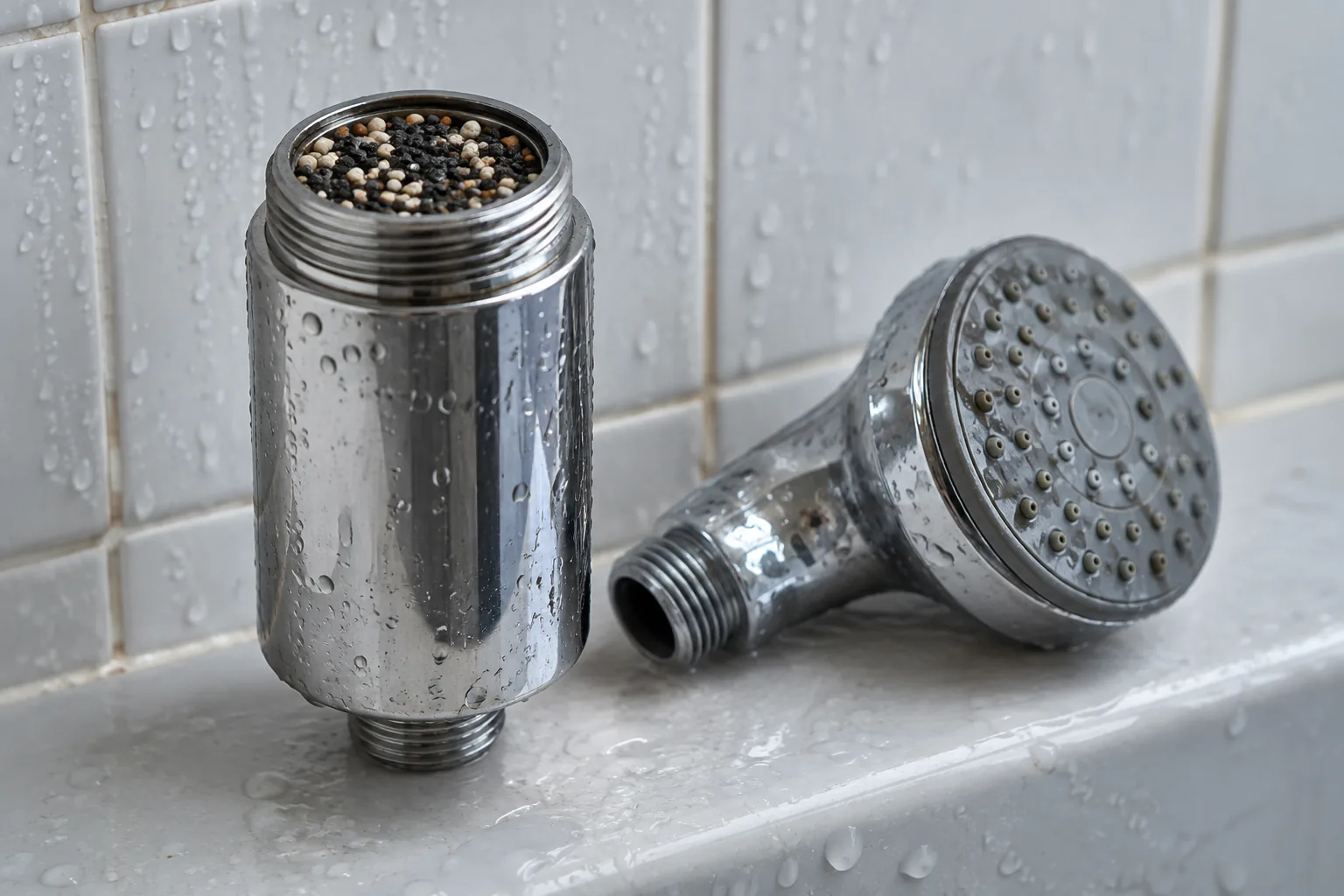
A shower filter is a chlorine filter, not a softener: it leaves the dissolved calcium and magnesium that make limescale exactly where they were.
✓ 5-Second Summary & Core Facts
- Almost everything a shower cartridge does is aimed at the chlorine or chloramine residual, which the US Environmental Protection Agency caps at 4.0 milligrams per litre.
- Hardness is dissolved calcium and magnesium; nothing in a standard shower cartridge has a mechanism for removing dissolved minerals.
- Water goes past a shower cartridge at up to around 7.6 litres a minute, so contact time is measured in fractions of a second.
- Taking hardness out needs ion exchange or a membrane, neither of which fits in a shower arm.
- The white crust on the showerhead nozzles is calcium carbonate left behind by hot hard water, and a filter in front of it does not stop it forming.
The short answer
A shower filter is a small cartridge that screws in between the pipe coming out of the wall and the showerhead, and nearly everything it is built to do is done to the chlorine in the water. It does not take out the calcium and magnesium that leave the chalky white crust on the glass and the nozzles, so it is not a softener and it will not stop limescale.
That is not a verdict on whether they are any good. It is a statement about mechanism: the stuff packed inside a shower cartridge reacts with or sticks to a disinfectant, and dissolved hardness minerals are a completely different kind of problem that needs a completely different kind of hardware. Everything below is the long version of why those two things do not overlap.
What is actually in the water arriving at the shower
Two things matter for this article. The first is the disinfectant residual. Water companies add a disinfectant and leave some of it in the water all the way to the house, and the EPA's National Primary Drinking Water Regulations describe this as necessary for the control of microbial contaminants. The same regulations set what the EPA calls a maximum residual disinfectant level — the highest amount allowed to be left in the water — of 4.0 milligrams per litre for chlorine and 4.0 milligrams per litre for chloramines, which are chlorine combined with ammonia. The World Health Organization lists chlorination among the standard ways drinking water is disinfected.
The second is hardness. That is dissolved calcium and magnesium picked up from rock, and the United States Geological Survey classifies it in milligrams per litre as calcium carbonate: up to 60 is soft, 61 to 120 moderately hard, 121 to 180 hard, and anything above 180 very hard. Hardness is not a health-based regulated contaminant in the United States. The EPA deals with this sort of thing through secondary drinking water standards, which it describes as non-enforceable guidelines for nuisance effects such as taste, colour and staining, and which set a guideline of 500 milligrams per litre for total dissolved solids — the whole of what is dissolved in the water, hardness minerals included.
So the hot water hitting the tiles has a disinfectant in it and, depending where you live, a load of dissolved rock. A shower filter is designed around the first one.
A shower is a difficult place to put a filter
Flow rate is the reason. A showerhead carrying the EPA's WaterSense label has to use no more than 2.0 gallons a minute, which is about 7.6 litres, and the federal maximum for showerheads is 2.5 gallons a minute, about 9.5 litres. All of that has to go through a housing roughly the size of a fist, and it has to go through without the shower turning into a dribble.
That matters because the main way carbon cleans water is adsorption — contaminants stick to the enormous internal surface of the carbon — and sticking takes time. It is the same constraint that shows up in jug filters, where water falls through the carbon under nothing but gravity, and the reason a carbon block is compressed into a solid wall rather than left as loose grains. A shower cartridge gets the opposite of generous contact time. The water is moving fast, it is hot, and it is in there for a fraction of a second.
What is inside the cartridge
Open one up and you generally find some combination of three things: granular activated carbon, granules of a copper and zinc alloy, and calcium sulphite. They work in two different ways.
Carbon traps. Things adsorb onto its surface and stay there until the surface is full, which is why carbon has a life and then stops working.
The copper-zinc granules and the calcium sulphite react instead. Rather than trapping chlorine, they convert it — free chlorine becomes chloride, which is an ordinary dissolved salt and stays in the water. Nothing is captured; a chemical is changed into a less reactive one. That is a sensible design choice for a device with almost no contact time, because a fast reaction beats a slow adsorption when the water is only passing through for an instant.
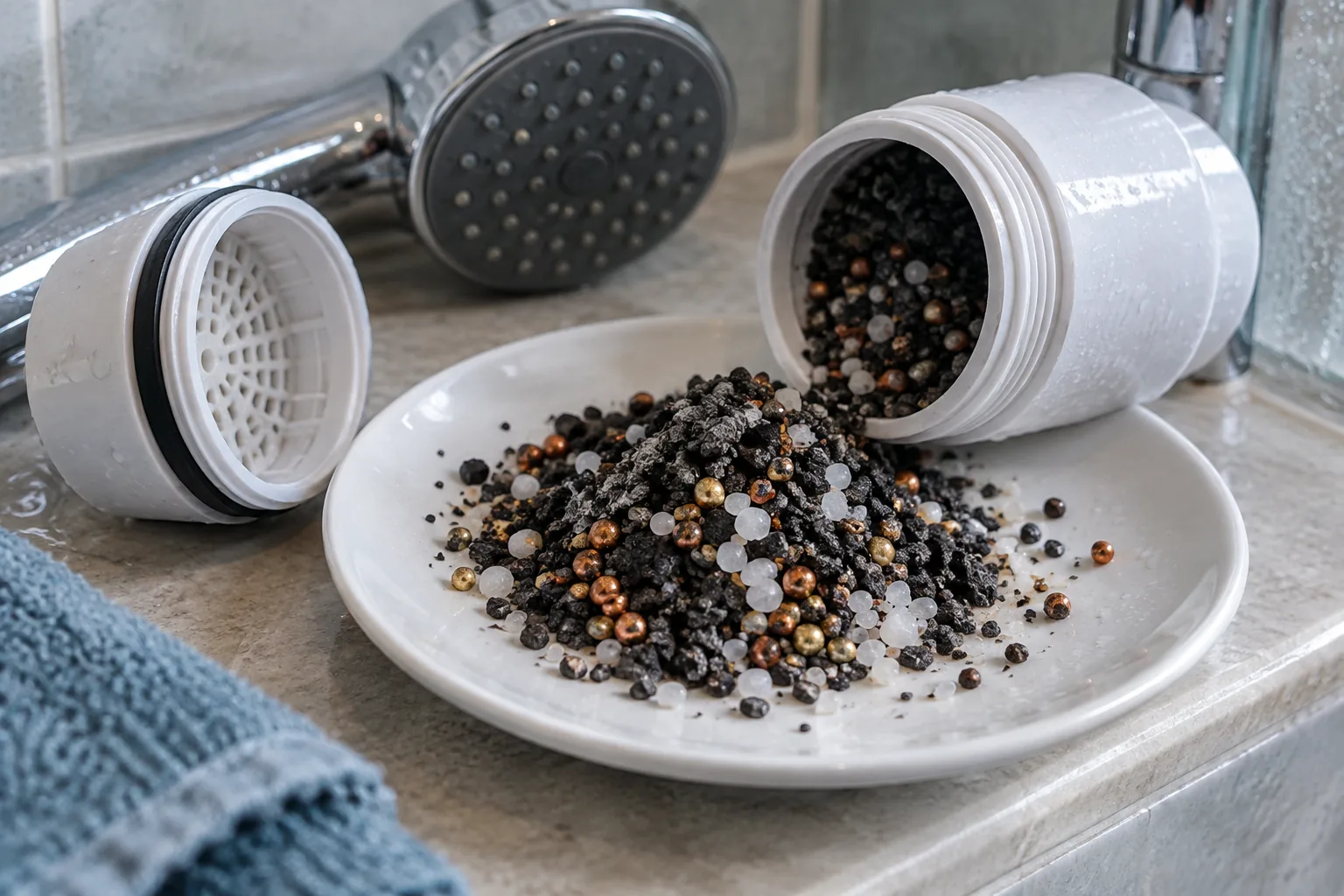
Look at that list again, though. Every one of those media is aimed at a disinfectant. None of them is a mechanism for removing a dissolved metal ion like calcium.
Why none of it touches limescale
Limescale is what hot hard water leaves behind. The calcium and magnesium are dissolved, invisible, and perfectly happy in cold water; heat and evaporation drive them out of solution as a solid, which is the chalk on the nozzles and the film on the glass door.
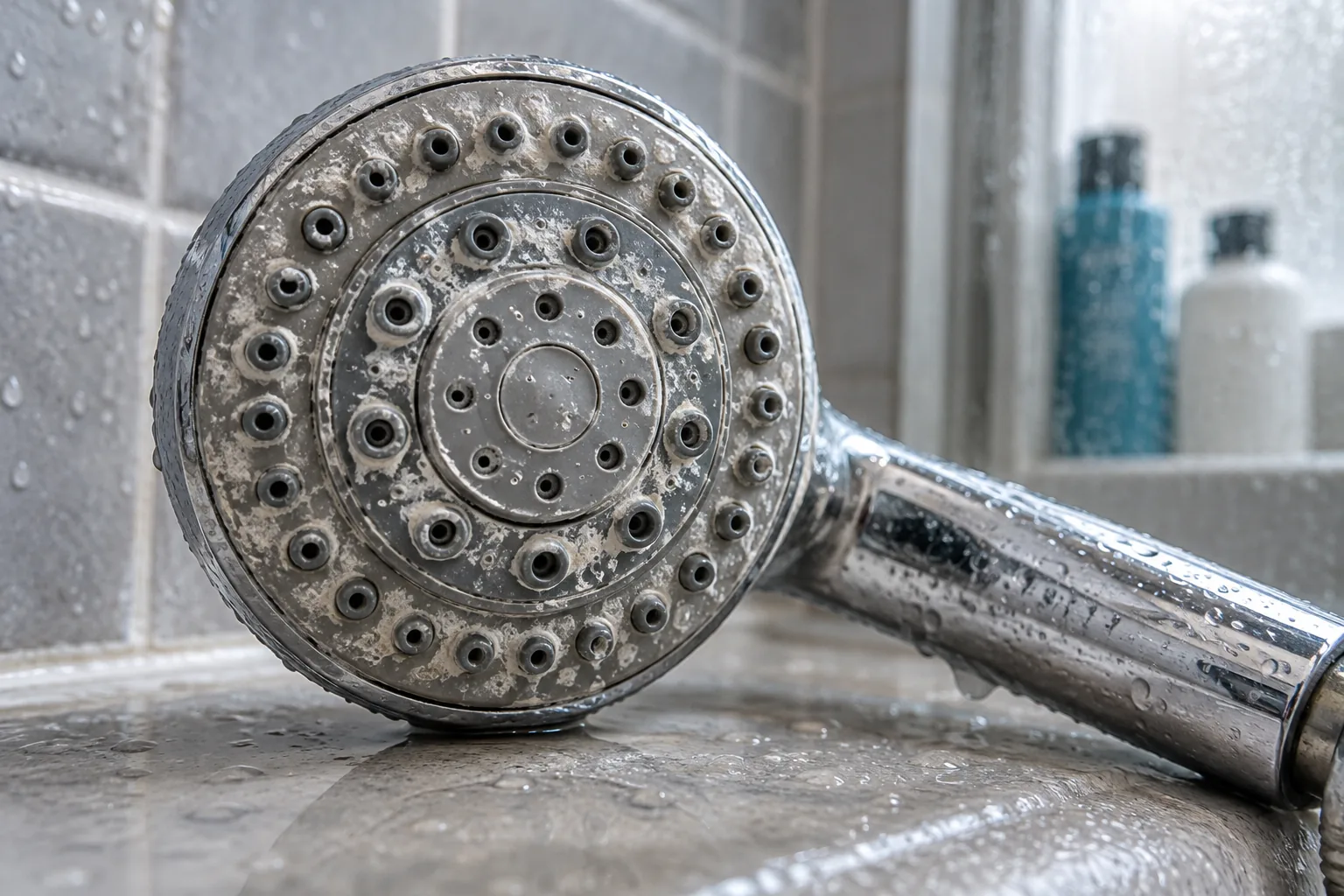
To stop that, you have to get the calcium and magnesium out of the water before it is heated, and there are only two common ways to do it. One is ion exchange, where the water passes over a bed of resin beads that swap the calcium and magnesium for sodium and are then flushed and recharged with brine. The other is pushing the water through a membrane fine enough to hold dissolved ions back, which needs pressure and produces water slowly.
Neither one fits in a shower arm. A resin bed big enough to handle 7.6 litres a minute is a tank, and it needs a drain and a brine supply to regenerate. A membrane that rejects dissolved salts cannot pass a shower's worth of water in real time. A cartridge that screws onto a pipe has no room, no drain and no way to regenerate anything, which is why shower cartridges are not sold as softeners even by people with every reason to sell them as softeners.
So what does it do, honestly
It reduces the disinfectant residual in the water, to a degree that depends on the media, the flow rate and how old the cartridge is. The most obvious everyday consequence is the smell: chlorine is volatile, steam carries it, and a small bathroom concentrates it. That is an aesthetic effect, and aesthetic is the right word for the honest version of the claim.
What it does not do is change the hardness of the water, which means the glass still films over, the nozzles still crust up, and the kettle downstairs is unaffected either way. Claims about what any of this does to skin or hair are outside what this article covers; the plumbing is not, and the plumbing is clear.
How to find out which of these applies to you
Your water supplier's annual water quality report names the disinfectant used on your supply — chlorine or chloramine — and usually gives a hardness figure, either in milligrams per litre as calcium carbonate or in grains per gallon. Put that number against the USGS bands above and you know whether limescale is your problem at all. If the water is soft, a filter in the shower arm was never going to be about scale. If it is very hard, it still is not — but at least you then know what kind of equipment the problem actually needs.
Sources
Every figure in this guide traces to one of the documents below.
- US Environmental Protection Agency National Primary Drinking Water Regulations epa.gov Government / academic
- US Environmental Protection Agency Secondary Drinking Water Standards: Guidance for Nuisance Chemicals epa.gov Government / academic
- United States Geological Survey Hardness of Water usgs.gov Government / academic
- US Environmental Protection Agency WaterSense: Showerheads epa.gov Government / academic
- World Health Organization Drinking-water who.int Government / academic