The Micron Scale: Why Pore Size Decides What a Filter Stops
A filter is a sieve with a measured hole size. This explains what a micron is, why a smaller number is not automatically better, and why the things people worry about most are often the things a sieve cannot catch at all.
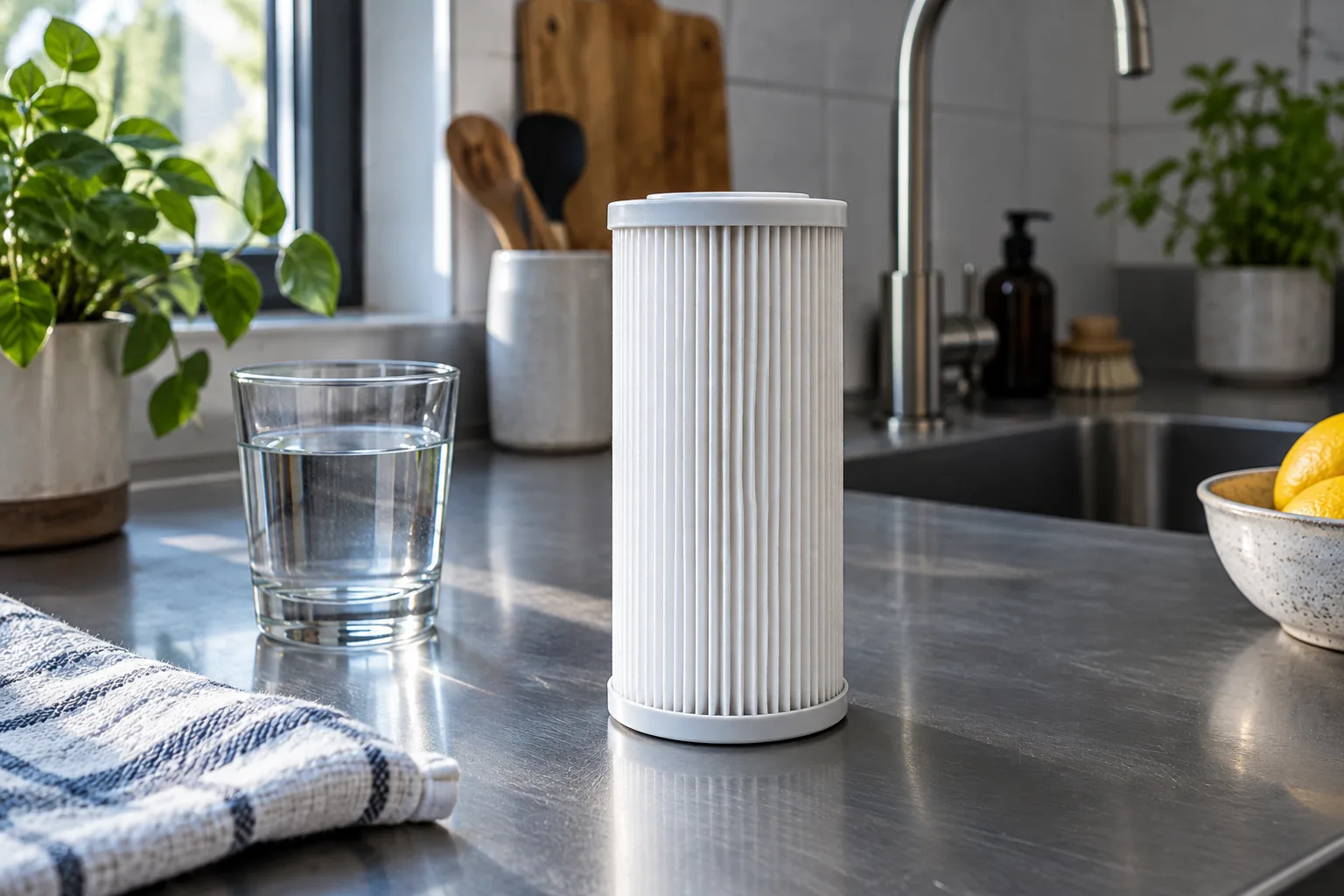
Pore size decides what a physical filter can block, so anything smaller than the pore passes straight through. Dissolved substances are smaller than any pore, which is why they need a different mechanism entirely rather than a finer sieve.
✓ 5-Second Summary & Core Facts
- A micron is one thousandth of a millimetre, far too small to see.
- A filter can only block particles wider than its pores.
- Dissolved substances are not particles and slide through any pore.
- A "nominal" rating is an average; an "absolute" rating is a guarantee.
- Smaller pores clog faster, which is why real systems use stages.
Every physical water filter works the same way a sieve does. Water goes through the holes. Anything wider than the holes does not. That single idea explains most of what a filter can and cannot do for you, and it explains why two filters that look identical on a shelf can perform completely differently.
The holes are measured in microns. Once you know what a micron is, filter labels stop being marketing language and start being a specification you can actually read.
What a micron actually is
A micron is one thousandth of a millimetre. Put another way, a thousand microns laid side by side would make one millimetre, which is roughly the thickness of a credit card.
Nothing at this scale is visible. The dot at the end of this sentence is somewhere around three hundred microns across. A grain of fine sand might be a hundred. Bacteria are a few microns. The things drinking water regulations concern themselves with are mostly smaller still.
| Roughly how wide | In microns |
|---|---|
| A credit card, edge on | about 1,000 |
| The full stop ending this row | about 300 |
| A grain of fine sand | about 100 |
| A bacterium | a few |
| The pore the CDC advises against Cryptosporidium | 1 or smaller, absolute |
| A dissolved molecule | smaller than any pore |
Read the last row twice. It is the one that decides which half of this article applies to you.
So when a filter says it is rated at five microns, it is telling you the size of gap the water squeezes through. Nothing that measures more than about five microns across gets past. Everything narrower does.
Nominal and absolute are not the same promise
This is the distinction that matters most on a label, and it is the one most often glossed over.
- A nominal rating is an average. A filter described as nominal five micron removes most particles around that size, but its pores vary, and some larger particles find a wider gap and slip through.
- An absolute rating is a ceiling. Nothing above the stated size gets through, because no pore in the material is wider than that.
For taste and grit the difference rarely matters. For anything that could make someone ill it matters a great deal. This is why the US Centers for Disease Control and Prevention specifically advises looking for a filter with an absolute pore size of one micron or smaller, or one certified for cyst reduction, when the concern is the parasite Cryptosporidium. An average is not a guarantee, and for a pathogen you want the guarantee.
The thing a sieve cannot do
Here is where most people's mental model breaks, and it is worth slowing down for.
A sieve catches particles — small solid pieces floating in the water. Many of the substances people are most concerned about are not particles at all. They are dissolved, which means their individual molecules have separated and spread evenly through the water, the way sugar disappears into tea.
A dissolved molecule is smaller than any pore in any filter. There is no micron rating fine enough to sieve it out, because the water and the dissolved substance are travelling through the same gap together. Lead that has dissolved off old plumbing behaves this way. So do nitrates, and so do the industrial fluorinated compounds covered in our guide to PFAS and where they come from.
If a substance is dissolved, the micron number on the box is answering a question you did not ask.
Removing dissolved substances takes a different mechanism altogether. Two are common in homes:
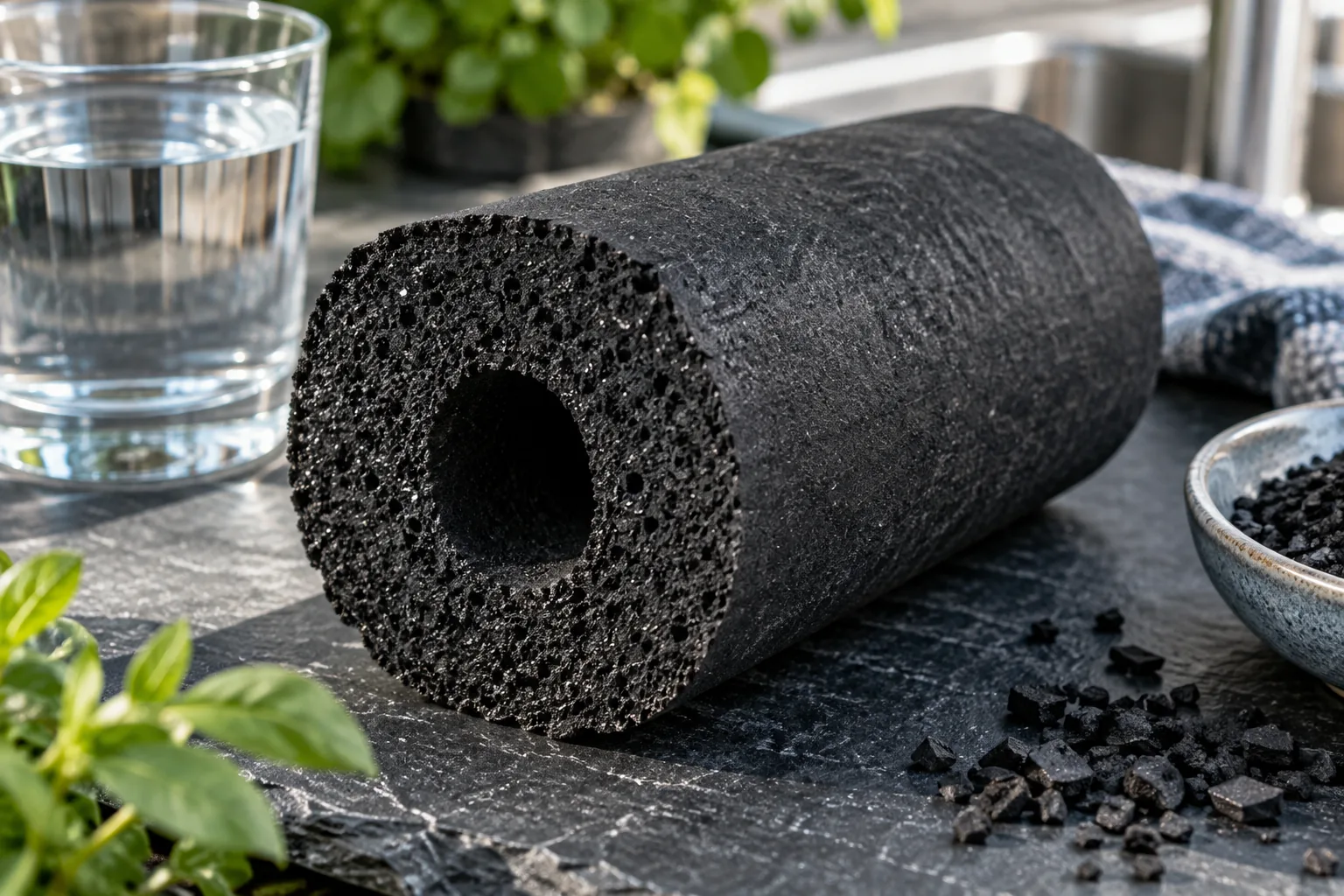
- Adsorption. Activated carbon does not strain anything. It has an enormous internal surface area, and certain molecules stick to that surface as the water flows past. It is chemistry, not geometry, which is why a carbon filter can be effective against one dissolved compound and useless against another.
- Reverse osmosis. A semipermeable membrane is pushed against by household water pressure. As the US Geological Survey explains, water molecules are forced through the membrane while most dissolved substances are held back and flushed away. This is not a finer sieve — it is a different physical process.
Why smaller is not simply better
If a one micron pore beats a five micron pore, why not make everything as fine as possible?
Because fine pores block. A filter fine enough to catch very small particles fills up with the larger debris first, and once the pores are packed the flow slows to a trickle. Push harder and water starts finding the paths of least resistance instead of passing evenly through the medium.
That is why a well-designed system is built in stages rather than as one heroic filter. A coarse sediment stage takes out rust, sand and grit. A carbon stage handles chlorine taste and a range of dissolved organic compounds. Only then does water reach a membrane, if there is one, arriving clean enough that the expensive part is not doing the cheap part's work.
Ordering matters as much as rating. Each stage exists to protect the one behind it.
Why a pitcher and an under-sink system are not the same tool
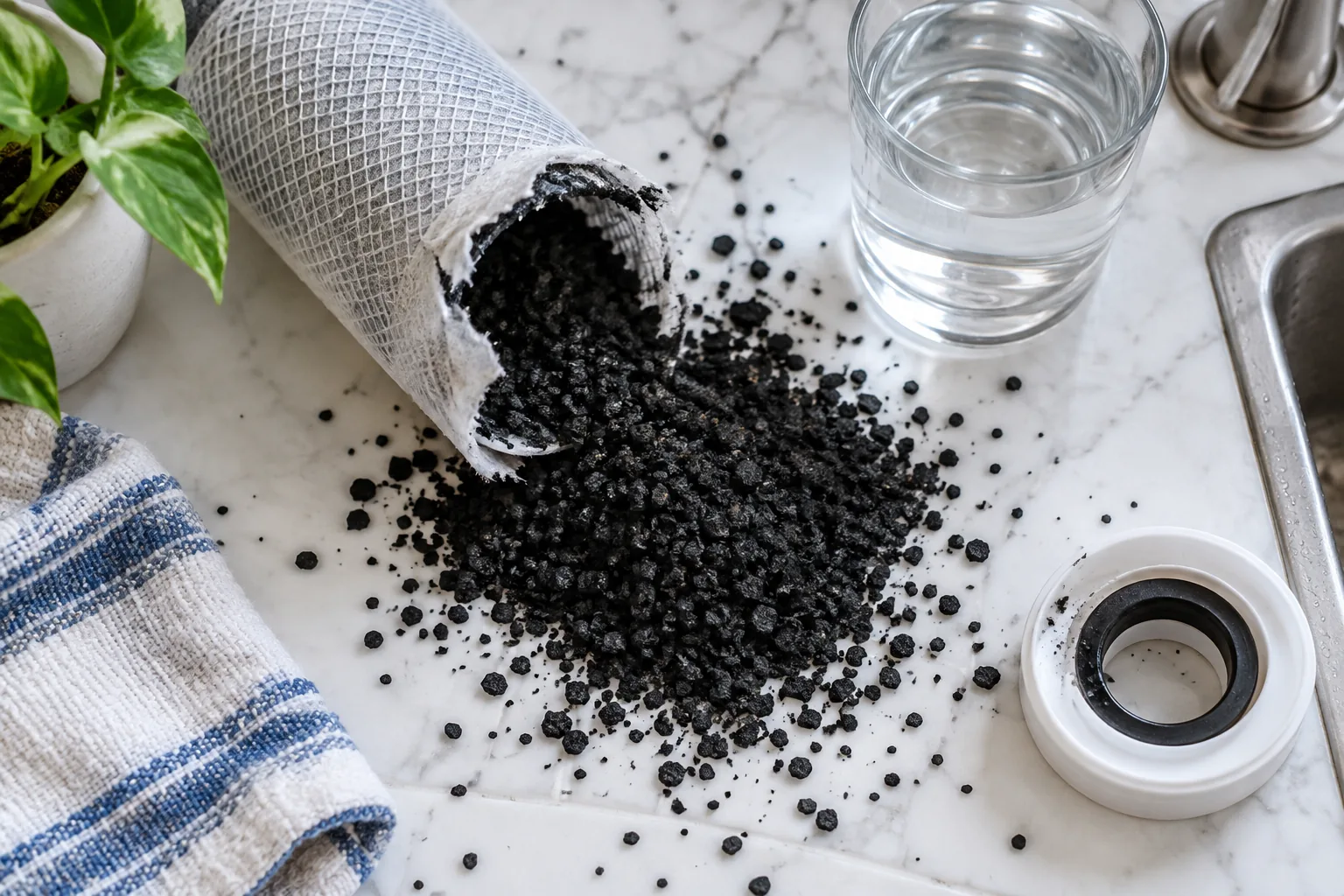
Most jug filters use loose granules of carbon rather than a solid compressed block. Water finds its way between the granules, and the spaces between loose grains are wide compared with the pores in a solid block. That is enough contact for chlorine taste, which is the job most jugs are genuinely good at. It is much less contact than a compressed block gives.
We have looked at what that means in practice in why pitchers struggle with contaminant tests. The short version is that gravity gives the water very little time and very little pressure, and a filter's performance depends heavily on both.
Where plastic particles sit on this scale
Plastic fragments are one of the few widely discussed contaminants that genuinely are particles, which means pore size is the right question to ask about them. The difficulty is that they span an enormous range of sizes, from pieces visible under a basic microscope down to fragments far below a micron. A filter rated for one part of that range says nothing about the rest. We go into the measurement problem in our guide to plastic particles in tap and bottled water.
How to read a filter label now
Three questions, in this order.
- Is the rating nominal or absolute? If the label does not say, treat it as nominal.
- Is the substance I care about a particle or dissolved? If it is dissolved, the micron number is not the specification to read. Look for what the unit is certified to reduce instead.
- Has an independent body tested it for that specific reduction? A pore size is a physical measurement. A reduction claim is a test result, and the two are not interchangeable.
Underneath all of this sits a public record worth reading first. The US Environmental Protection Agency publishes enforceable limits for contaminants in public drinking water, and your supplier has to report against them. Knowing what is actually in the water arriving at your house tells you which of these mechanisms is relevant to you — and quite often the answer is that the water already meets the standard, and what you want is better-tasting water rather than a different kind of protection.
A micron rating is a useful number. It is just a smaller number than most labels imply, and it answers a narrower question than most people are asking.
Sources
Every figure in this guide traces to one of the documents below.
- US Centers for Disease Control and Prevention Water Filters cdc.gov Government / academic
- US Centers for Disease Control and Prevention About Home Water Treatment Systems cdc.gov Government / academic
- US Geological Survey, Water Science School Reverse Osmosis usgs.gov Government / academic
- US Environmental Protection Agency National Primary Drinking Water Regulations epa.gov Government / academic