Under-Sink Filters: What Actually Happens in the Cabinet
An under-sink filter is a sealed cylinder plumbed into the cold pipe inside the cabinet, so every drop reaching the tap is forced through the cartridge by mains pressure. This explains each part, why it is teed into the cold line, what carbon and membranes physically do, and what changes as a cartridge loads up.
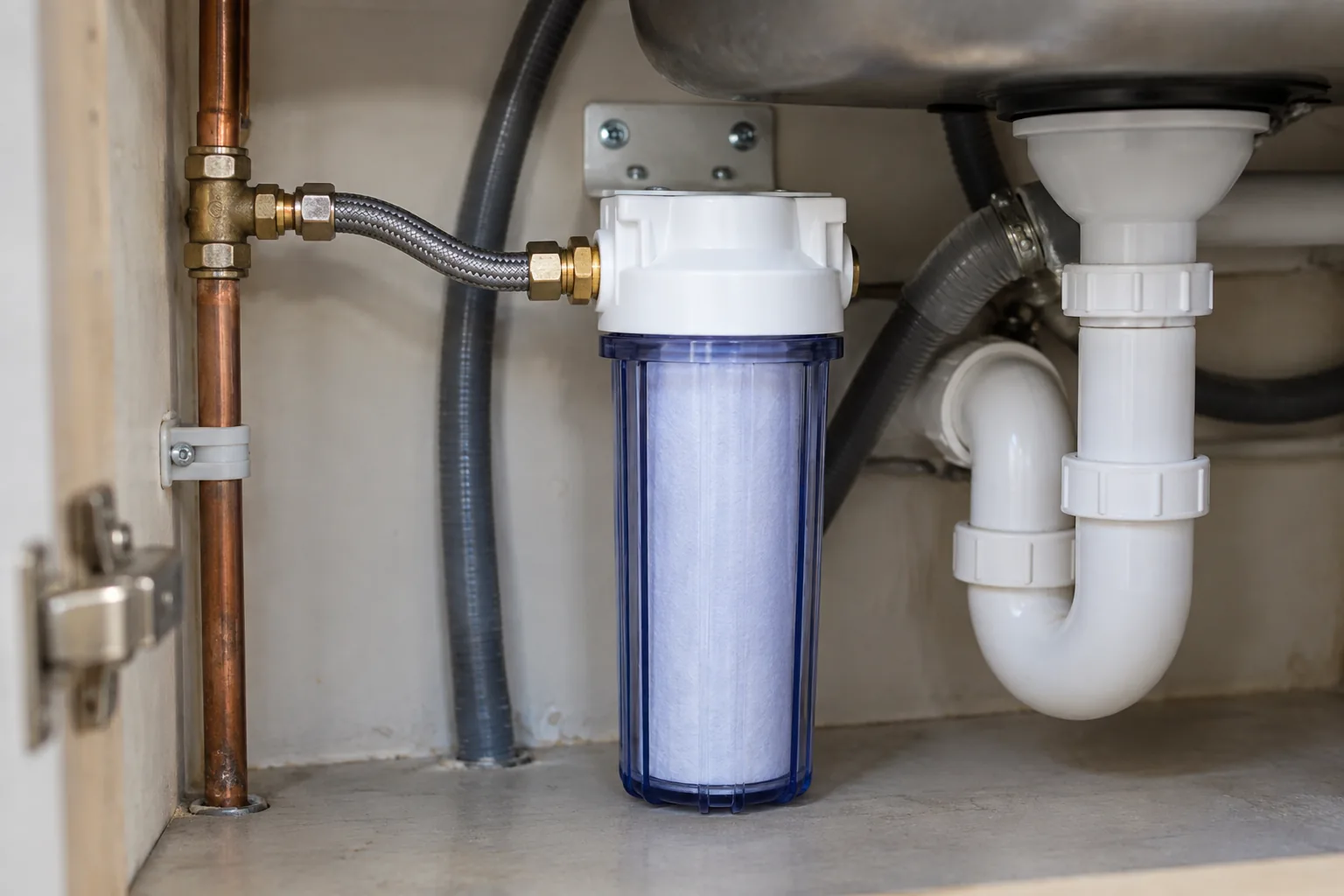
An under-sink filter works by putting a cartridge directly in the cold pipe so mains pressure pushes the water through it on the way to one tap, and that pressure is the whole mechanical difference from a jug.
✓ 5-Second Summary & Core Facts
- The water gets to the tap only by going through the cartridge, which is why the plumbing matters as much as the filter material.
- It is teed into the cold pipe; the EPA advises using only cold water for drinking and cooking, saying hot water is more likely to contain higher levels of lead.
- Mains pressure lets the cartridge be dense and the water slow, which is the opposite of gravity through a jug insert.
- Carbon blocks hold things on their surface; reverse osmosis membranes pass water molecules and send the rest to the drain.
- It treats one tap only, and nothing about a loaded cartridge is visible from the outside.
- The legal limits it is measured against come from regulators, not from the filter: the EPA's lead action level is 15 parts per billion.
An under-sink filter is a sealed cylinder plumbed into the cold water pipe inside your kitchen cabinet, so the water coming out of the tap has already been pushed through filter material by mains pressure. Everything that makes it behave differently from a jug on the worktop comes from those two facts: the water is under pressure, and it has no route to the tap except straight through the cartridge.
Here is what is actually in the cabinet, what each part does, and why the plumbing is arranged the way it is.
What is actually in the cabinet
Strip it back and there are only four things.
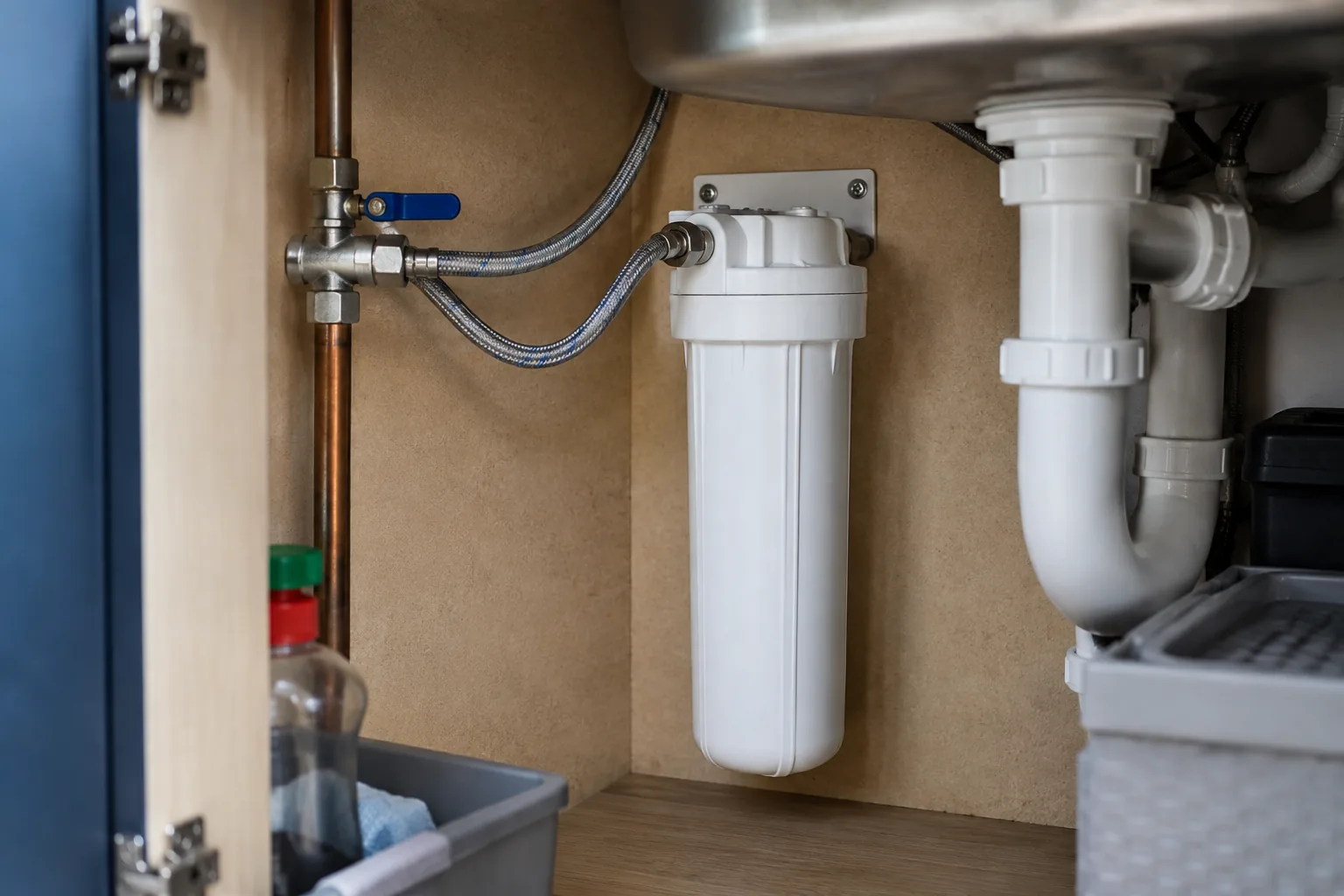
- A tee on the cold supply. A T-shaped fitting cut into the cold pipe that feeds the kitchen tap, usually with a small isolating valve on the branch so that one line can be shut off without turning the water off for the whole house.
- A hose to the filter. Flexible tubing from that branch to the inlet of the filter head.
- The housing. Two parts: a head that the pipes screw into, and a sump, which is a tall plastic cup that screws up onto the head and holds the cartridge. A rubber O-ring between them takes the pressure.
- A hose out. From the outlet, either up to a small separate tap set into the worktop, or back into the cold side of the existing mixer.
The cartridge is the only part that does anything to the water. Every other component exists to hold it still, seal it and deliver water to it at pressure.
Why it is always the cold pipe
The branch is taken from the cold line rather than the hot one, and that is deliberate rather than convenient. The US Environmental Protection Agency (EPA), the federal body that sets drinking water standards in America, advises using only cold water for drinking and cooking, and states that hot water is more likely to contain higher levels of lead. Filtering the hot line would be filtering water nobody is supposed to be drinking anyway.
There is a practical reason too. Cartridge media and the plastic sump that holds them are built for cold mains water, not for the temperature and pressure swings of a hot supply.
Pressure is the point
A jug filter has one force available: gravity, acting on a few centimetres of water. That is a very weak push, so the material inside has to be loose enough for water to trickle through in a couple of minutes, and the water is in contact with it only briefly. This is the whole reason jug filters struggle on contact time and pressure.
Under the sink, the push comes from the mains. That changes what is possible: the material can be packed dense, the cartridge can be much larger than a jug insert, and the water can take a longer path through more of it and still come out of the tap at a normal rate. Filtration is not instant chemistry. Most of it depends on how many seconds the water spends touching the material, and pressure is what buys those seconds without leaving you standing at the sink.
Carbon and membranes are doing different jobs
Nearly every under-sink cartridge is one of two things, or a set of both in a row.
A carbon block is carbon powder compressed into a solid tube with a hollow core. Water is forced in through the wall and out through the middle, and substances that stick to carbon are held on its enormous internal surface as they pass. Nothing is destroyed; it accumulates inside the block.
A reverse osmosis membrane works on a different principle entirely. Pressure pushes water against a film that lets water molecules through and leaves most dissolved material behind on the incoming side. That leftover material has to go somewhere, which is why these systems have a second small pipe clamped to the waste trap: a continuous stream of concentrated water runs to the drain while the system is producing.
You will often see a sediment cartridge first in the line, rated in microns. A micron is a thousandth of a millimetre, and the rating is roughly the size of particle the pores will stop, so the coarse grit is caught before it reaches the finer, more expensive stages behind it.
Why a membrane system has a tank
A carbon block filters at the speed you open the tap. A membrane cannot: pushing water through that film is slow, measured in litres per day rather than litres per minute. So reverse osmosis systems store what they make in a small pressurised tank, usually lying on its side in the cabinet, and the tap draws from the tank rather than from the membrane. That tank, the drain line and the extra hose are why a membrane system fills a cabinet and a single carbon cartridge does not.
What changes over the following months
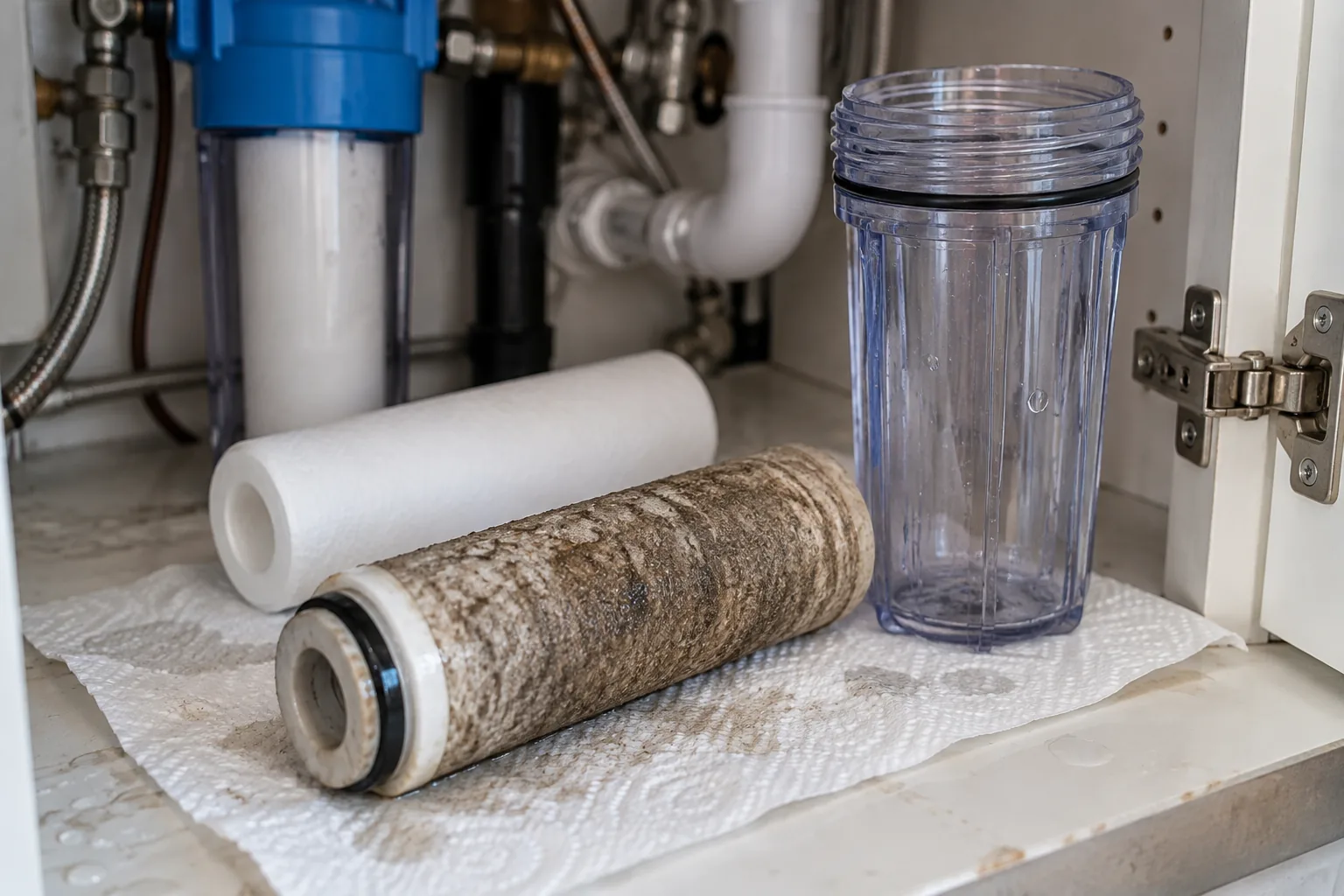
A cartridge does not wear out like a battery. It fills up. Particles block the pores at the surface, and the material that holds substances on contact gradually runs out of places to hold them. Two things happen as that goes on: flow through the tap drops, and the cartridge stops doing what it did when it was new.
The important part is that only the first one is visible. The outside of a housing looks identical on the day it is fitted and a year later, which is why change intervals are given as a volume of water or a number of months rather than as something to look for. A slowing tap is a sign the cartridge is blocking with particles; it is not a reliable signal for anything else.
What it does not change
An under-sink unit is point-of-use equipment. It treats water at the one tap it is plumbed to, and it does nothing at all for the bathroom, the shower, the outside tap or the pipework upstream of it. The pipe between the street and the cabinet is exactly the same pipe it was before.
It also does not change the standard your supply is held to. Those come from regulators. The EPA's National Primary Drinking Water Regulations are legally enforceable limits for public water systems, setting a maximum contaminant level of 0.010 milligrams per litre for arsenic, for example. For lead, the EPA sets an action level of 15 parts per billion, while its maximum contaminant level goal, the non-enforceable target, is zero. The World Health Organization publishes its Guidelines for Drinking-water Quality, which many countries use as the basis for setting their own national standards. Those numbers exist whether or not anything is fitted under a sink.
Start with what is in the water
The choice between a carbon block and a membrane, and whether a sediment stage is needed in front of either, is decided by what is actually in the supply rather than by what fits in the cabinet. Water suppliers publish quality data for each supply zone, and that report is free. The plumbing under the sink is the last decision, not the first one.
Sources
Every figure in this guide traces to one of the documents below.
- US Environmental Protection Agency Basic Information about Lead in Drinking Water epa.gov Government / academic
- US Environmental Protection Agency National Primary Drinking Water Regulations epa.gov Government / academic
- World Health Organization Drinking-water who.int Government / academic