Reverse Osmosis: What the Membrane Actually Does
A plain explanation of how reverse osmosis works: the pressure, the membrane, the filters either side of it, the water that goes to the drain, and how what it removes lines up with the limits regulators publish.
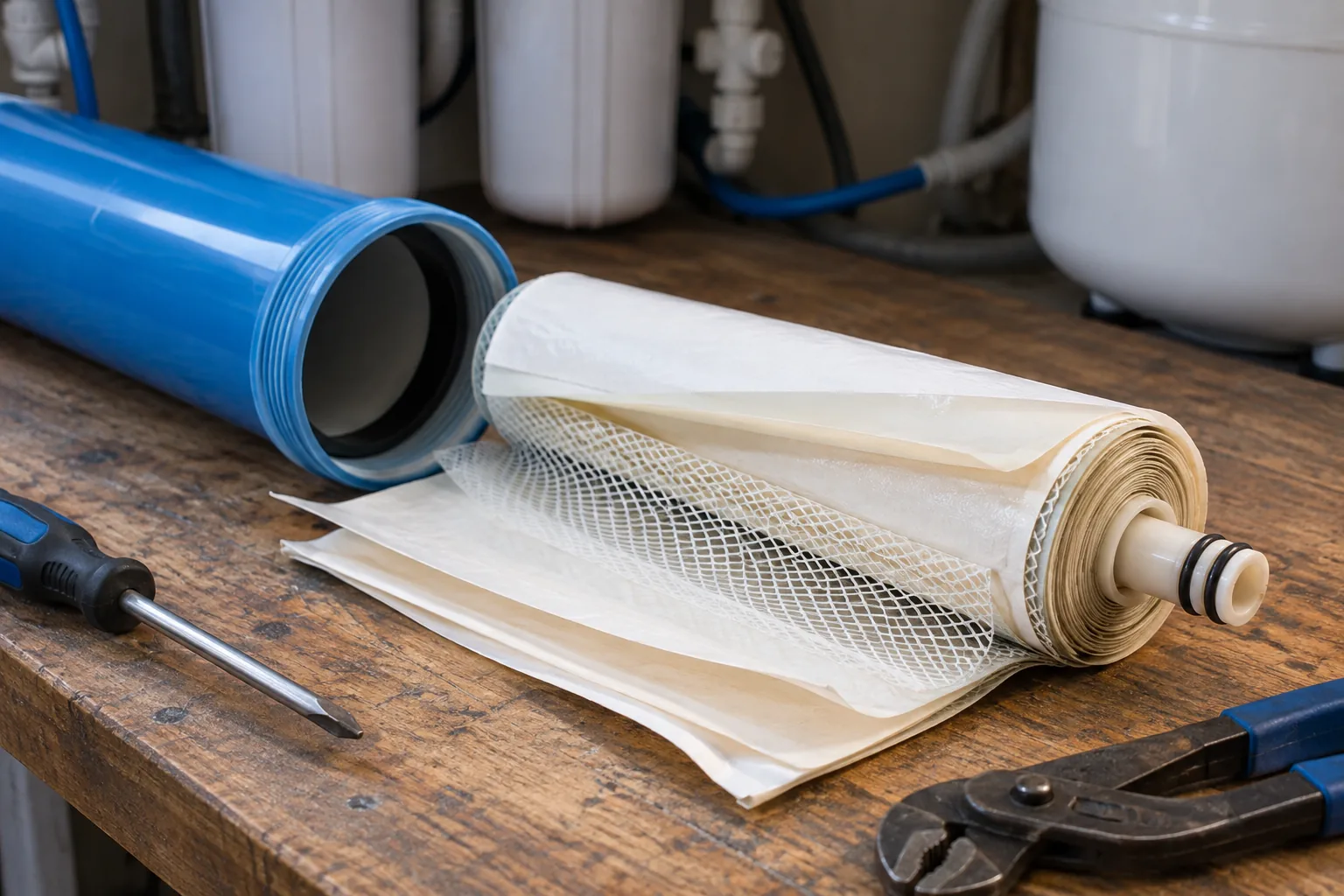
Reverse osmosis uses mains pressure to push water through a dense plastic membrane that most dissolved substances cannot cross, which is why it removes so much — including the ordinary minerals — and why some water goes down the drain while it works.
✓ 5-Second Summary & Core Facts
- Osmosis is water drifting towards the saltier side of a membrane; reverse osmosis uses pressure to force it back the other way.
- The membrane is a dense film, not a sieve, so dissolved things like sodium, calcium, nitrate and lead are mostly left behind.
- Sediment and carbon stages sit before the membrane, and a small carbon stage usually sits after it.
- Because dissolved solids pile up on one side, a second stream of water carries them to the waste pipe.
- The US Environmental Protection Agency sets enforceable limits for more than 90 contaminants; your own report tells you which ones are actually present where you live.
Reverse osmosis is a filter driven by pressure: mains water is pushed hard against a thin plastic sheet whose gaps are so small that water molecules get through and most of the substances dissolved in the water are left behind. It removes more than almost any other filter that fits under a kitchen sink, it sends a second stream of water down the drain while it works, and it takes out the ordinary minerals along with everything else.
That is the short answer. The rest of this is what the membrane is physically doing, what the other stages around it are for, and how any of it lines up with the limits that regulators actually publish.
Osmosis, and then the reverse of it
Put salty water on one side of a suitable membrane and plain water on the other, and water drifts by itself towards the salty side until the two sides are closer to equal. That drift is osmosis, and it happens with no help from anyone.
Reverse osmosis is exactly what the name says. Push hard enough on the salty side and you force water back the other way, leaving the dissolved material behind. In a kitchen system the push comes from the pressure already sitting in your cold water pipe, which is why these systems are plumbed in rather than poured into.
The membrane itself is not a sieve with holes you could ever see. It is a dense film, rolled up in a spiral inside a cylinder roughly the size of a large rolling pin. Water molecules work their way through the film; bigger molecules, and dissolved particles that carry an electrical charge such as sodium, calcium, nitrate and lead, mostly cannot follow. That is a much finer job than a carbon block does, and if pore size is the part you want to picture properly, the micron scale is the place to start.
Why it trickles instead of pours
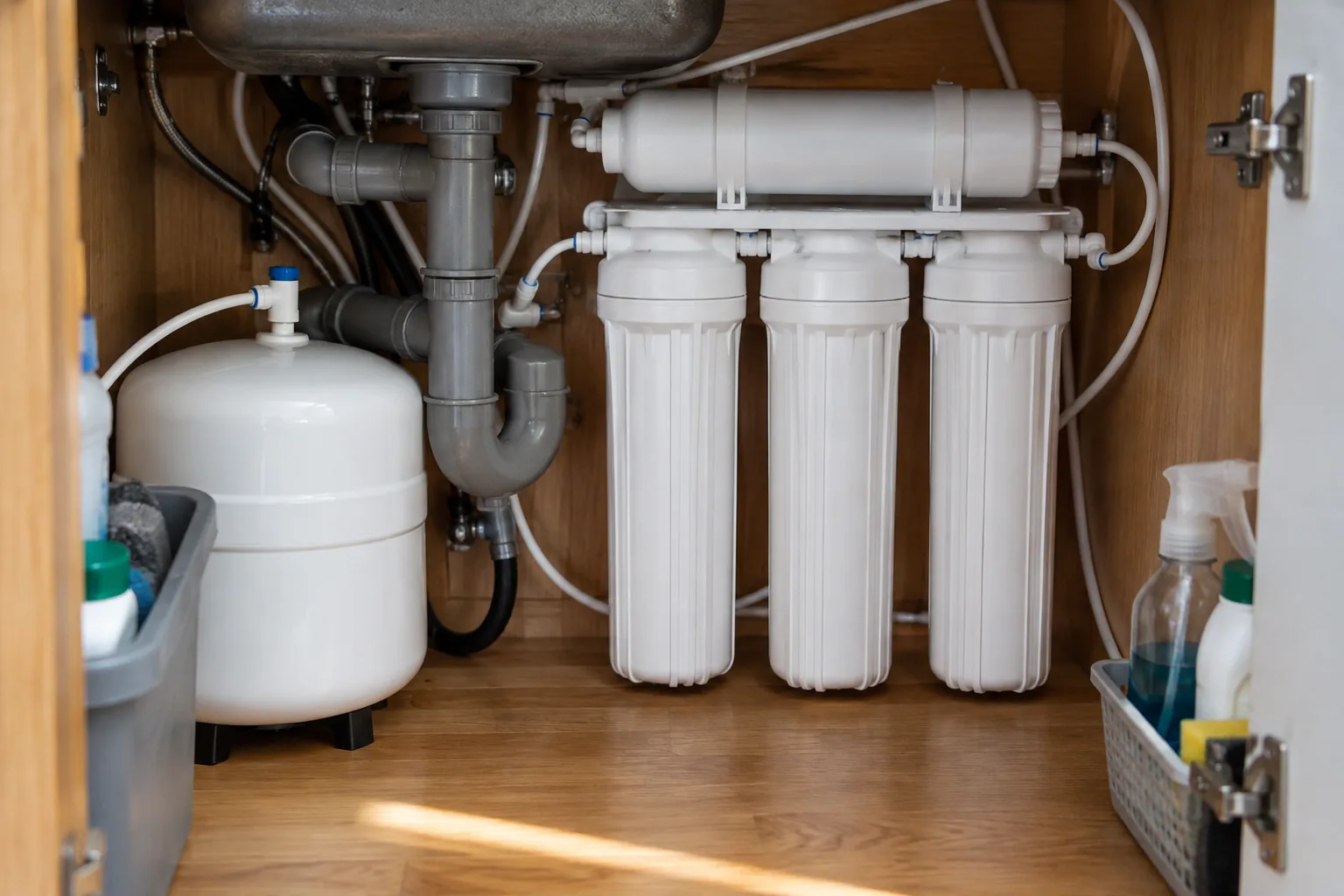
Pushing water through something that dense is slow. A system like this produces a thin stream rather than a jet, so it fills a small storage tank quietly in the background and the tank is what supplies the little separate tap on the sink. When you draw a jug off in ten seconds, you are emptying the tank, not the membrane.
That slowness is the same principle that decides how well any filter performs: water has to stay in contact with the filtering material long enough for the material to do its job. It is why jug filters struggle in contaminant tests — a jug gives the carbon a few seconds of gravity, while a plumbed system gives the membrane mains pressure and as long as it needs.
The stages either side of the membrane
A reverse osmosis unit is never just a membrane. In front of it sit one or two cartridges doing coarser work.
- A sediment cartridge — spun or pleated fibre that catches grit, rust flakes and the fine particles that come loose from pipework.
- A carbon cartridge — activated carbon, which is carbon processed so that a small block of it has an enormous internal surface area. Chlorine and many of the compounds that carry taste and smell stick to that surface as water passes through.
- A final carbon stage, usually after the membrane and after the tank, to tidy up the taste of water that has been sitting still.
So the membrane is doing one specific thing in the middle of a chain, and the cartridges around it are doing the jobs it is not suited to.
What the limits actually are
The US Environmental Protection Agency (EPA) sets legally enforceable limits, called maximum contaminant levels, for more than 90 contaminants in public drinking water. A few of them give you a feel for the scale involved. The EPA's limit for arsenic is 10 micrograms per litre — 10 parts per billion. Its limit for nitrate is 10 milligrams per litre, measured as nitrogen.
Lead is handled differently. Rather than a simple limit at the treatment works, the EPA sets an action level of 15 parts per billion, because lead generally enters the water from the pipes and fittings between the main and the tap rather than from the source. That distinction matters for filtration, because it means the metal can appear at your kitchen tap and not in the water leaving the plant.
Outside the United States, many countries build their own standards on the guideline values published by the World Health Organization in its drinking-water quality guidelines, so the same substances turn up in national rules with broadly similar numbers.
Minerals, taste, and the letters TDS
TDS stands for total dissolved solids: everything dissolved in the water added together, mostly calcium, magnesium, sodium, chloride and sulphate. The EPA lists total dissolved solids at 500 milligrams per litre under its secondary drinking water standards, which are non-enforceable guidelines covering things like taste, colour and staining rather than enforceable limits.
A membrane does not sort the list. It holds back dissolved material because it is dissolved material, so the calcium and magnesium that make water hard go the same way as the sodium and the nitrate. That is why reverse osmosis water often tastes flat or blank to people used to a hard supply: a large part of what they were tasting has gone. Some systems add a stage afterwards that puts a little mineral content back, purely for taste.
The water that goes to the drain
This is the part that surprises people. Everything the membrane holds back stays on the incoming side, and it cannot simply pile up there — the film would clog within days. So a second stream of water runs continuously across the face of the membrane, carrying the concentrated leftovers away to the waste pipe.
It is not a design flaw or a fault in a particular unit. Any process that concentrates dissolved solids on one side of a barrier has to flush that side, and the trickle you hear going down the drain is what that flushing sounds like.
Where to start with your own water
None of the mechanism above tells you whether it is relevant to your kitchen, because that depends entirely on what is in the water arriving at your address. The useful first step is the water quality report for your own area, which your supplier publishes and which lists what was measured and what was found — the free report and the lab test covers what each one can and cannot tell you.
Read against that report, the mechanism starts to mean something. A membrane acts on dissolved things — metals, salts, nitrate. Carbon acts on chlorine and many organic compounds. A sediment cartridge acts on particles. Knowing which of those your supply actually contains is the difference between a mechanism that matters where you live and one that is solving a problem you do not have.
Sources
Every figure in this guide traces to one of the documents below.
- US Environmental Protection Agency National Primary Drinking Water Regulations epa.gov Government / academic
- US Environmental Protection Agency Secondary Drinking Water Standards: Guidance for Nuisance Chemicals epa.gov Government / academic
- US Environmental Protection Agency Basic Information about Lead in Drinking Water epa.gov Government / academic
- World Health Organization Guidelines for drinking-water quality: fourth edition incorporating the first addendum who.int Government / academic