PFAS in Drinking Water: What They Are and Why Boiling Makes It Worse
PFAS are a large family of synthetic fluorinated chemicals used to make surfaces repel water and grease. This explains where they come from, what the US Environmental Protection Agency now requires water systems to do about them, and why the two kitchen habits people reach for first are the wrong ones.
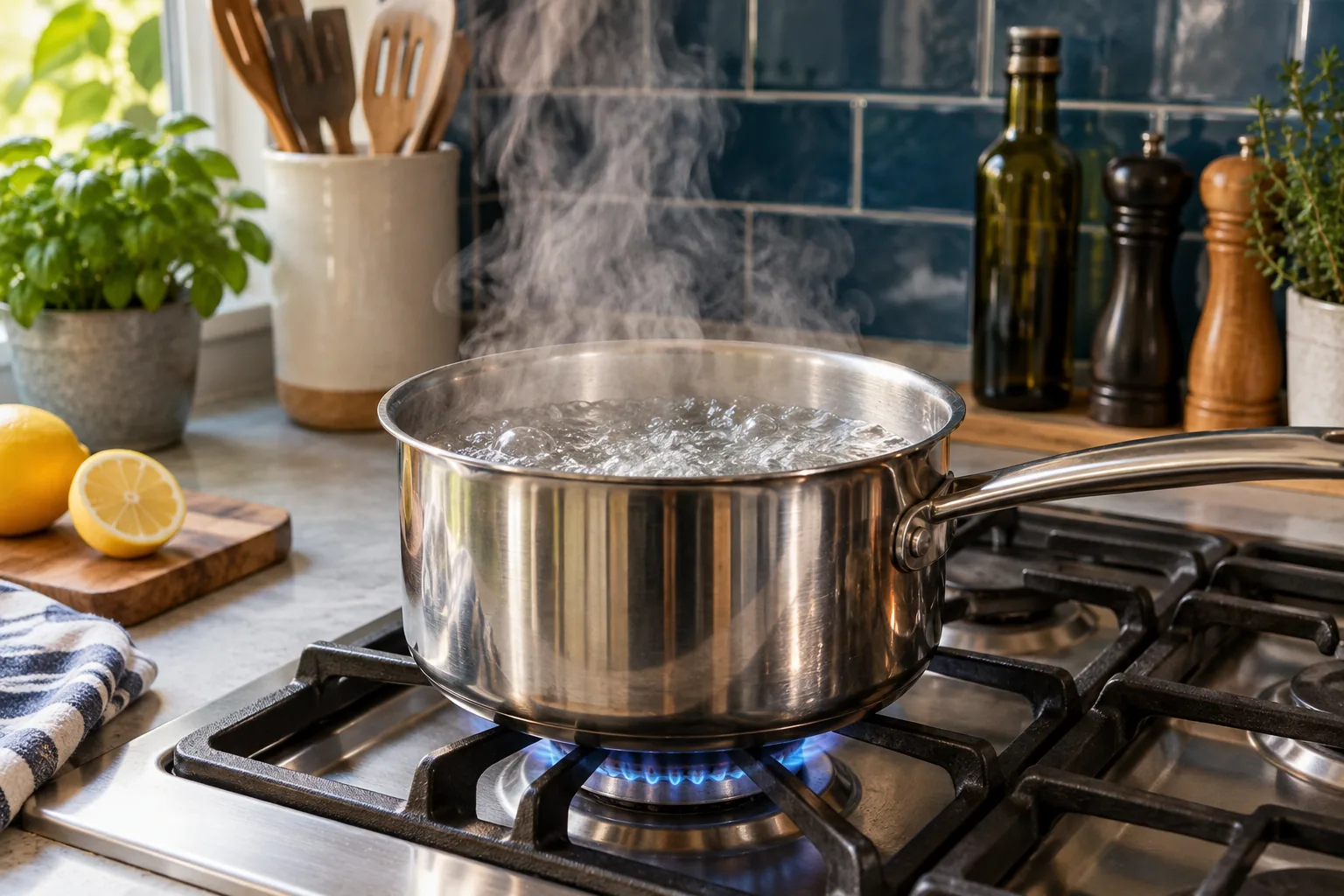
PFAS are dissolved, not suspended, so boiling concentrates them rather than removing them and a basic sieve cannot catch them. The US Environmental Protection Agency set enforceable national limits for several PFAS in drinking water in 2024, which means public suppliers now have to monitor and report them.
✓ 5-Second Summary & Core Facts
- PFAS are a family of thousands of synthetic fluorinated chemicals.
- The carbon-fluorine bond is why they persist for so long.
- Boiling removes water as steam and leaves the PFAS behind, more concentrated.
- They are dissolved, so pore size is not the specification that matters.
- The EPA set enforceable national drinking water limits in 2024.
PFAS stands for per- and polyfluoroalkyl substances. It is not one chemical but a family of thousands, all sharing a particular feature: chains of carbon atoms with fluorine attached along them.
That bond between carbon and fluorine is one of the strongest in organic chemistry. It is the reason these compounds are useful — they make surfaces shrug off water and grease, and they hold up under heat — and it is also the reason they are a problem. Very little in the environment breaks them apart, so once they are made they tend to stay made. Hence the nickname.

How they reach drinking water
PFAS have been manufactured since the middle of the twentieth century and used in a wide range of everyday products: non-stick coatings, stain-resistant and waterproof textiles, grease-resistant food packaging, and firefighting foams.
They enter water supplies from manufacturing sites, from places where firefighting foams were used repeatedly such as airfields, from landfill drainage, and from the general spread of products that contain them. Because they persist and dissolve readily, they move with groundwater rather than settling out, which is why contamination can show up some distance from any obvious source.
The US Environmental Protection Agency regulates several PFAS in drinking water under the National Primary Drinking Water Regulations, and it has revised its published assessment of them more than once as research has accumulated. That is an area of active science, and the honest description is that it is still moving — which is a reason to look at what your own supplier reports rather than to guess.
Boiling makes it worse, not better
This is the single most important practical point, because boiling is the instinct almost everyone has.
Boiling works against microorganisms: heat destroys them. It does nothing to a dissolved chemical that is stable at those temperatures, and PFAS are notably stable. What boiling actually does is turn some of the water into steam and let it leave the pan.
The PFAS do not leave with it. They stay in the water that remains — which is now a smaller volume of water containing the same amount of dissolved chemical. The concentration goes up. Boil a pan down by a third and you have made the problem measurably worse.
Boiling is a disinfection step, not a purification step. Against a stable dissolved chemical it does the opposite of what it is reached for.
The same reasoning applies to any dissolved contaminant that is not destroyed by heat. Boiling is a disinfection step. It is not a purification step.
Why a sieve cannot help either
The second instinct is to buy a finer filter. That runs into a different wall.
A physical filter is a barrier with holes in it, and it can only stop things bigger than the holes. PFAS are dissolved: their molecules have dispersed through the water individually, so the water and the PFAS are travelling through the same gap side by side. There is no pore small enough, because the thing you are trying to exclude is smaller than a water-permeable barrier can discriminate against by size alone.
This is a general principle worth internalising, because it separates the contaminants a filter rating tells you about from the ones it does not. We set it out in detail in our guide to the micron scale and what pore size decides. In short: a micron number is the right specification to read for a suspended particle and the wrong one for a dissolved chemical.
The contrast with plastic fragments is instructive. Those genuinely are particles, and a stated pore size means something against them, which is why the questions to ask are different — we cover that in our guide to plastic particles in tap and bottled water.
What does work, and by what mechanism
Removing a dissolved compound needs something other than straining. The US Centers for Disease Control and Prevention notes that home treatment units work by several distinct mechanisms, and the mechanism is what determines whether a unit is any use for a given contaminant.
- Adsorption. Activated carbon presents an enormous internal surface area, and some molecules stick to it as water passes. Effectiveness varies by compound and declines as the medium loads up, which is why the replacement schedule is part of the performance rather than an afterthought.
- Membrane separation. Reverse osmosis pushes water through a semipermeable membrane under pressure, holding back a large share of dissolved substances and flushing them to waste.
- Ion exchange. Certain resins swap ions in the water for ions bound to the resin, which suits some compounds and not others.
In every case the thing to look for is independent certification for reduction of the specific contaminant, tested to a recognised standard. A pore size is a physical measurement of the material. A reduction claim is the result of testing the finished unit against a named substance. They are different kinds of statement and only the second one answers the question.
What changed in the regulations
For a long time PFAS in drinking water were addressed through health advisories, which are guidance rather than law.
In 2024 the US Environmental Protection Agency set enforceable national primary drinking water regulations for several individual PFAS and for certain mixtures of them. That is a substantive change in kind, not just in number. An enforceable limit means public water systems must monitor for these compounds, must report the results, and must act if they exceed the limit. Compliance is phased rather than immediate, so the picture will keep changing over the next several years.
The practical upshot for a household on a public supply in the United States is that PFAS are moving from something you had to go looking for into something your supplier has to tell you about.
What to actually do
- Read your supplier's annual water quality report. It is published and it is specific to your system. Guessing from national coverage is a poor substitute for a local measurement.
- Do not boil for this. It concentrates the contaminant. If you are boiling for microbial safety, that is a separate and valid reason.
- If you treat at home, match the mechanism to the contaminant and look for certification naming the compound, not a micron rating.
- Check what a unit needs to keep working. Adsorption media exhaust and membranes foul. A unit past its service interval is not performing to the specification it was certified against.
PFAS are a real and well-documented issue, and they are also one of the clearest examples of why understanding the mechanism matters more than buying the finest-sounding filter. The two things most people try first — boiling and a tighter sieve — are the two that cannot work.
Sources
Every figure in this guide traces to one of the documents below.
- US Environmental Protection Agency Per- and Polyfluoroalkyl Substances (PFAS) and Drinking Water epa.gov Government / academic
- US Environmental Protection Agency PFAS Explained epa.gov Government / academic
- US Environmental Protection Agency Our Current Understanding of the Human Health and Environmental Risks of PFAS epa.gov Government / academic
- US Environmental Protection Agency National Primary Drinking Water Regulations epa.gov Government / academic
- US Centers for Disease Control and Prevention Water Filters cdc.gov Government / academic