Carbon Block Filters: What the Compressed Carbon Actually Does
A plain explanation of how a carbon block filter works: what activated carbon is, why the carbon is pressed into a solid cylinder instead of left loose, what sticks to it, and what passes straight through untouched.
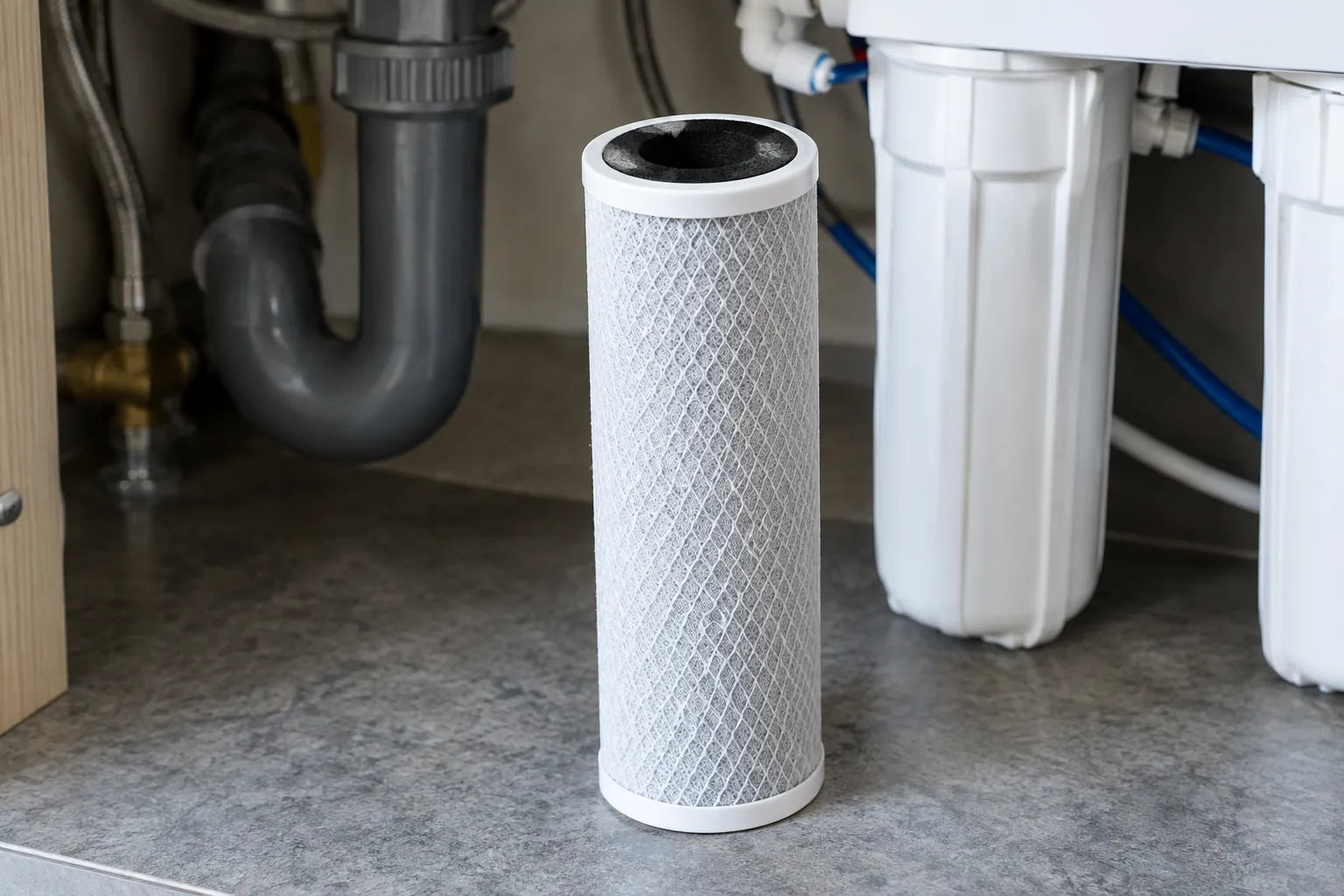
A carbon block is fine activated carbon pressed into a solid cylinder, and water forced through its wall leaves behind the things that stick to carbon — chlorine and many organic chemicals — while dissolved minerals and salts go through as if the filter were not there.
✓ 5-Second Summary & Core Facts
- A carbon block is powdered activated carbon compressed with a binder into a hard cylinder, not loose grains in a pot.
- It mostly works by adsorption: substances stick to the carbon's surface as water squeezes past, so time and contact matter more than pressure.
- The solid wall also acts as a sieve, which is why blocks carry a micron rating and loose granular carbon usually does not.
- Dissolved minerals, salts and hardness pass through carbon untouched — it is not a softener and not a desalinator.
- Carbon fills up with what it has collected, and it gives no visible warning when it does, which is why cartridges are dated rather than judged by eye.
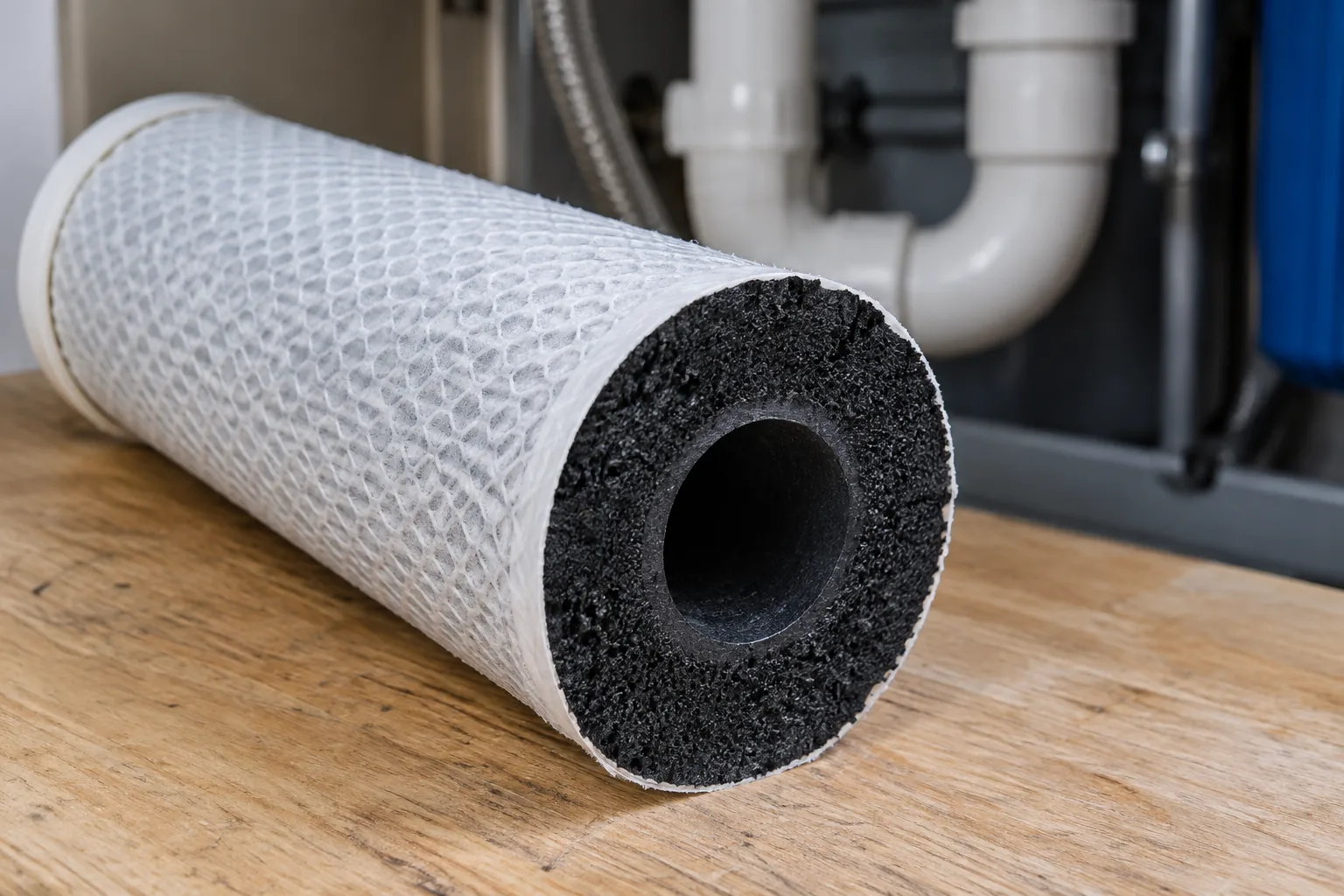
A carbon block is a solid cylinder of extremely fine activated carbon powder, pressed together with a binder until it sets hard, and your water is pushed through the wall of that cylinder from the outside in. Most of what it deals with is not strained out like crumbs in a sieve — it sticks to the carbon surface as the water squeezes past, a process called adsorption.
That one word is the whole story. Once you know what sticks to carbon and what does not, the rest of it — why blocks are solid, why they have a micron number on the box, why they stop working with no warning — falls into place.
What "activated" carbon actually is
Activated carbon starts as something ordinary that was once alive: coconut shell, wood, or coal. It is heated in a furnace with very little oxygen, so it chars rather than burns, and then treated with steam or chemicals at high temperature. That second step is the "activation", and it riddles every grain with a maze of pores far too small to see.
The point of all that pore space is surface. A small handful of activated carbon has an internal surface area out of all proportion to its size, because the surface is not the outside of the grains — it is the inside of millions of tiny tunnels running through them. Adsorption happens on surfaces, so more surface means more places for a chlorine molecule or an organic compound to land and stay.
This is also why carbon is fussy about what it collects. Molecules that are not very comfortable in water — chlorine, the compounds behind a musty or earthy taste, many organic chemicals — will happily leave the water and cling to carbon. Things that dissolve into water very happily, like the calcium in hard water or ordinary salt, have no reason to leave it, so they sail straight past.
Why a block, and not loose grains
Plenty of filters use loose granular activated carbon: small dark grains poured into a cartridge. The problem with loose grains is that water is lazy. It finds the easiest route through the bed, wears that route wider, and after a while most of the flow is racing down a few channels while the carbon either side of them sits barely used. The industry word for it is channelling.
Pressing the carbon into a solid block removes the easy route. There are no gaps between grains to open up, so the water has to work its way through the pore structure of the block itself, touching carbon the entire way. That contact time is the thing that decides how much gets adsorbed, which is the same reason jug filters struggle in contaminant tests — gravity gives the water a few seconds through a small bed of granules, where a plumbed-in block under mains pressure gets far longer against far more carbon.
The trade-off is flow. A dense block resists water, which is why they are usually installed under a sink with household pressure behind them rather than being poured through by hand.
The block does a second job as a sieve
Because the carbon is compacted, the gaps left between the particles are small and fairly consistent, and that gives the block a genuine pore size. This is where the micron rating comes from. A micron is a thousandth of a millimetre, and a carbon block described as one micron is one whose pores will not pass particles bigger than that — sediment, rust flakes, and some larger biological particles that are physically too big to fit.
So a carbon block is doing two unrelated things at once: straining by size, and adsorbing by chemistry. They are separate mechanisms and a block can be good at one and mediocre at the other, which is why the micron number alone never tells you what a filter handles. It describes the sieve, and says nothing about the adsorption.
Some blocks are built with extra materials mixed into the carbon for specific jobs. The US Environmental Protection Agency's guidance on lead in drinking water points households towards filters certified to a standard called NSF/ANSI 53 — a testing standard written by the standards body NSF International with the American National Standards Institute — rather than towards carbon in general, because "contains carbon" and "was tested against lead" are very different statements.
What carbon does nothing about
Carbon has no effect on dissolved minerals. The calcium and magnesium that make water hard go through a carbon block unchanged, so the block will not stop limescale in a kettle and is not a water softener. Sodium, nitrate and most dissolved salts are the same story: they are comfortable in water and carbon gives them no reason to leave.
Removing dissolved substances needs a different mechanism entirely, which is what a reverse osmosis membrane does — pressure forcing water through a barrier the dissolved material cannot cross. That is also why under-sink systems often contain both: a carbon block in front to take out chlorine, and a membrane behind it.
Why it wears out quietly
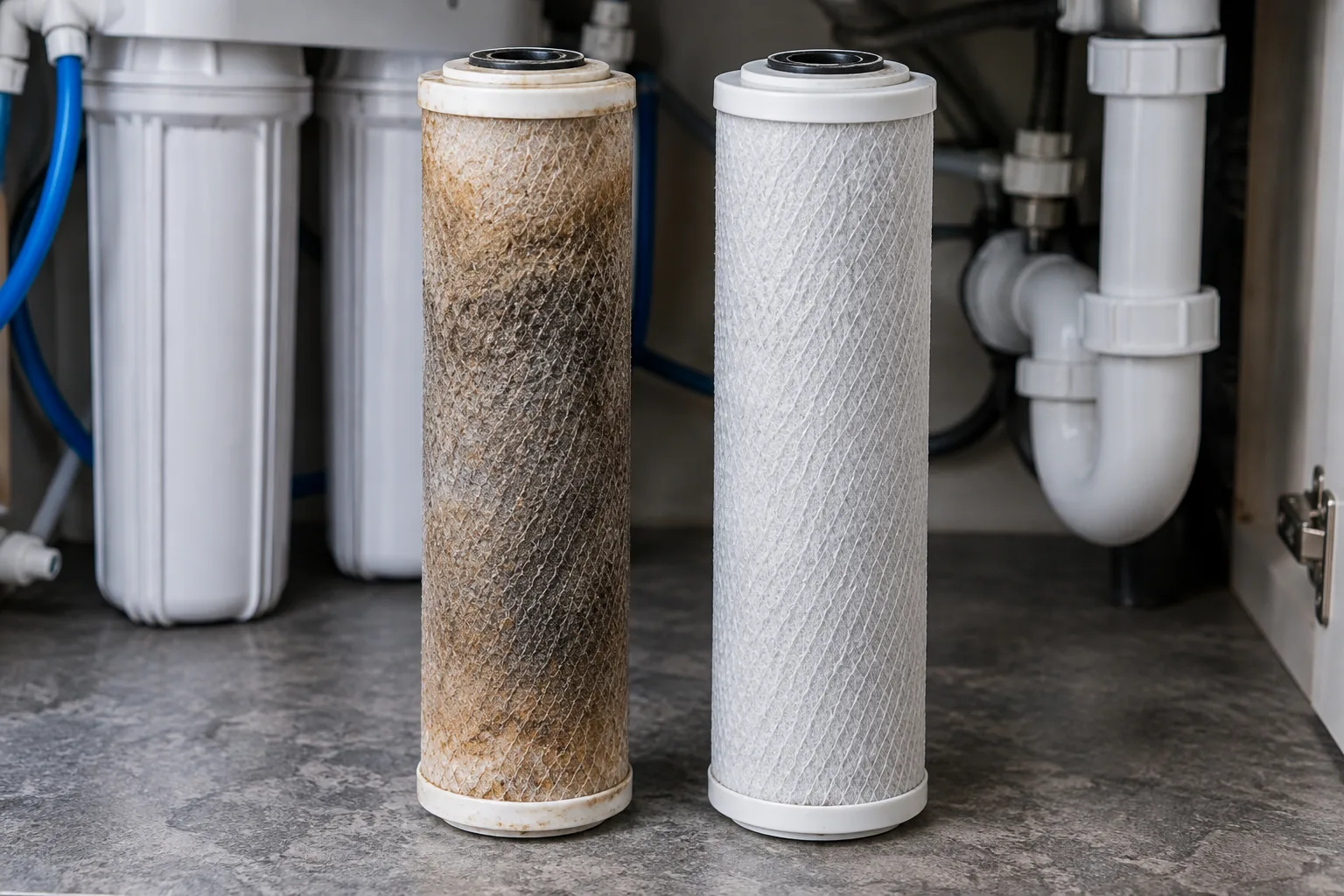
A carbon block does not break. It fills up. Every molecule that sticks to the carbon occupies a site that is then unavailable, and when enough sites are taken the water simply carries on through with less and less being removed. Nothing changes colour, the flow does not necessarily slow, and the water does not taste of anything new. The only honest way to manage a carbon cartridge is to change it on the schedule its manufacturer gives, usually stated in litres or months, whichever comes first.
There is one visible clue, and it is not about the carbon. If the block also has a sediment wrap around the outside, that wrap goes brown or grey as it collects rust and grit. That tells you about the particles, not about how much adsorption capacity is left inside.
Where the chlorine comes from in the first place
Chlorine is in tap water on purpose, and both the dose and its by-products are regulated. Under the EPA's National Primary Drinking Water Regulations, the maximum residual disinfectant level for chlorine is 4.0 milligrams per litre, and the maximum contaminant level for total trihalomethanes — a group of compounds the same regulations list as a by-product of drinking water disinfection — is 0.080 milligrams per litre. The World Health Organization publishes its own Guidelines for drinking-water quality, which many national standards around the world are built from.
Those numbers are set at the treatment works and at the tap, long before any filter is involved. A carbon block at your sink is working on water that has already been through them.
The short version
A carbon block is compressed activated carbon with an enormous hidden surface area, and it removes things by giving them somewhere to stick rather than by blocking their way. It is good at chlorine, tastes and odours, and many organic chemicals. It is a sieve for particles down to its micron rating. It does nothing at all to dissolved minerals or salts. And it stops working silently, on a schedule you have to trust rather than see.
Sources
Every figure in this guide traces to one of the documents below.
- US Environmental Protection Agency National Primary Drinking Water Regulations epa.gov Government / academic
- US Environmental Protection Agency Basic Information about Lead in Drinking Water epa.gov Government / academic
- World Health Organization Drinking-water who.int Government / academic